Rabies: My recent first-hand experience with the deadly virus

By Tony Pilkington/Breckenridge Texan
Living in a rural area, two of my biggest fears start with the letter R – rattlesnake bites and rabies. Over the past few weeks, I’ve had to face one of those fears after I was bitten on the finger by a kitten that was later determined to have rabies. What followed has been quite a ride, to say the least.
I want to share my story and what I’ve learned along the way. I’ve covered many of these stories over the years, but it’s mostly been from a distance and with just basic information about a specific incident. I hope what I’ve learned will help others here and in rural areas like ours be better informed about rabies, how to prevent their animals – and themselves – from getting it, and to provide a firsthand look at what to expect if they are exposed to rabies.
Living in a rural area like Stephens County – a place with limited resources and 70 miles from the nearest large city – can create challenges that city residents don’t necessarily face when handling an exposure to rabies. For me, it involved a trip to Austin and multiple trips to Brownwood.
The whole process was somewhat daunting. Fortunately, we have very knowledgeable people here in Breckenridge and the surrounding area who helped me figure out the next step all along the way.
While talking to each expert during my ordeal, they all agreed this would make a good story and a great way to inform the public about the dangers of rabies, how to prevent its spread in our area, and what to expect if you do get exposed.
So here’s my story. It’s long and detailed, but I want everyone to understand the complexities involved in dealing with a rabies exposure.
How it started
It all began a few months ago when a calico cat walked up our driveway, introduced herself, and said she now lives here. I didn’t think much of it; we live out in the country and cats just show up here from time to time. Some stay; some leave after a short while; and others fall prey to predators like coyotes. That’s life for a cat in our rural area.
This one was friendly enough and seemed tame, so we started feeding her outside, along with a couple of other outdoor cats that live here. After a couple of months, she had a litter of six kittens.
Like her, they lived outside and were destined to become what country folks call barn cats. As the kittens grew and started running around, we tried to handle them as much as possible to tame them. That way, we could round them up for vet visits or possibly find homes for some.
After about eight or 10 weeks, they were getting quite big, running around, playing, exploring the area, and racing to the food bowl at feeding time, like most kittens do. They were also tame, acting just like normal kittens. Then one day, one of them slipped through the back door and came into the house. When I picked her up, she was very wiggly and tried to get away, not acting crazy, but just like a typical kitten that doesn’t want to be held. As I held on to her to take her outside, she bit me. It was a hard bite, and she made a couple of deep holes in my finger, which bled quite a bit. But I wasn’t too concerned and just applied some antiseptic and a bandage.
I watched her throughout the day, and she seemed fine. I even saw her the next morning with the other kittens when I went out to feed them. Then Carla and I went to town, and when we came back a few hours later, she was lying dead next to the back steps. That’s when the alarm bells started ringing in my head.
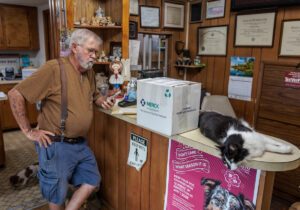
Dr. Gary Fambro, a local veterinarian and the Stephens County rabies control officer, calls the rabies testing lab in Austin to let them know that a specimen was about to leave his office last month. (Photo by Tony Pilkington/Breckenridge Texan)
At the vet’s office
After finding the kitten, I called veterinarian Dr. Gary Fambro’s office and told them what had happened. On their advice, I put the dead kitten in a box and headed to his office. I explained everything, and Dr. Fambro immediately realized the seriousness of the situation. In fact, as I remember it, he said, “If you want me to tell you not to worry about it and that it’s going to be fine, I can’t do that. The kitten dying after biting you is a red flag.”
Dr. Fambro is our veterinarian, but he’s also Stephens County’s rabies control officer. He said the kitten would need to be sent to Austin to be tested for rabies.
Under normal circumstances, it would have been a serious but routine situation. But, as it turned out, nothing about this was normal. The kitten died on the Friday before Memorial Day – a holiday weekend – and the rabies testing lab in Austin was going to be closed until the following Tuesday.
Additionally, we had to figure out how to get the deceased kitten – or specimen, as they call it – to the lab in Austin. Dr. Fambro explained that in the past, they would send the specimens to the lab by bus. But Breckenridge hasn’t had bus service for a long while.
Nowadays, he usually uses a commercial delivery service like UPS or FedEx. But, we were sitting there late on the Friday afternoon before a three-day holiday weekend, and time was an essential consideration.
All things considered, the package likely couldn’t be picked up before Tuesday. Then, it would take time for the package to go through the delivery company’s system and arrive in Austin. By Tuesday, it would be five days since I was bitten and four days since the kitten died. Any delay would threaten the viability of the specimen.
So, after some discussion, we decided it would be best if my wife, Carla, and I drove the specimen to Austin on Tuesday and dropped it off at the lab ourselves.
Even with that plan, Dr. Fambro was concerned about whether the specimen would still be viable after that amount of time, and he wanted to verify what would be the best way to preserve it until Tuesday. He called the lab in Austin and confirmed that keeping it refrigerated over the weekend would be fine.
He said he would keep it refrigerated at his office and get it prepared for the lab. Rabies testing is done on an animal’s brain tissue, so only the head needs to be sent to the lab.
Needless to say, it was a long weekend for me – and not in a good way. Fortunately, it was a busy weekend with lots of news to cover for the Breckenridge Texan, keeping my mind preoccupied. We had the Breckenridge High School graduation ceremony on Friday night, volunteers placing flags on veterans’ graves at the Breckenridge Cemetery on Saturday morning, and the Veterans’ Memorial Service in front of the courthouse on Monday morning.
Of course, there was still plenty of time to think about it when I let myself, but I didn’t really see the point in getting too worked up over it. To tell you the truth, I just assumed the test would come back negative.
But there was also the possibility that it would be inconclusive or indeterminate, which was pretty much the same as a positive result, because I would still have to take the treatment. So, from my perspective, there was a two out of three chance I would end up taking the shots.
When I told my family what happened, they seemed much more alarmed than I was. But, I guess sometimes when you’re looking in from the outside and not directly involved in a situation, it can seem scarier. Looking back at the stories about rabies that I’ve covered over the years, I suppose that’s how I usually saw it too – somebody possibly getting exposed to rabies and waiting for the test was a frightening prospect.
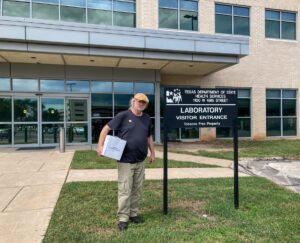
GPS made it easy enough for Tony Pilkington to find the Texas Department of State Health Services’ testing lab, but getting to the drop-off point at the back of the building still required a bit of a trek. (Photo by Carla McKeown/Breckenridge Texan)
The trip to Austin
When I arrived at Dr. Fambro’s office Tuesday morning, he had the specimen prepared and packed with ice packs, and had all the necessary paperwork ready to go. While I was there, he called the lab to let them know the specimen was on the way and would arrive by 4 p.m.
The trip to Austin was uneventful, long, and a bit strange, given what we were doing. It felt a little odd driving across Texas with part of a kitten in a box. My main concern was that we might get stuck in traffic and not get the specimen to the lab by 4 p.m. or even before it closed at 6 p.m. I was a little anxious, to say the least.
But we made it with plenty of time to spare.
Thanks to GPS, we easily found the Texas Department of State Health Services complex, which had several buildings. After wandering around a bit and talking to a couple of state employees, we found the delivery dock for the testing lab. We knew we were in the right place when we saw a City of Austin Animal Control truck parked there.
Dropping off the specimen was relatively simple. We filled out a form on a clipboard on a table on the loading dock. Then, we pushed a doorbell button, and a man came out, took the box, looked over the information on the clipboard, thanked us, and disappeared into the lab.
It seemed a little anticlimactic after our stressful weekend and mad-dash trip to Austin.
Back in the car, I called Dr. Fambro and let him know that I had dropped off the box at the lab and they had it.
After grabbing a bite to eat, we started heading back toward Breckenridge. Since we arrived in Austin so late and some bad thunderstorms were approaching, we decided to drive part of the way and spend the night along the route, then return to Breckenridge the next morning. To be honest, we didn’t have much of a choice; the storms were so severe that there was almost no visibility and water started rushing over the roadway. Many drivers kept their flashers on and drove about 10 mph or pulled over on the shoulder to wait it out.
We stopped in Lampasas for the night.
The results
The next morning, we got back on the road to Breckenridge.
We were stopped for a break in Eastland when Dr. Fambro called. He had just received the lab results, and they were positive. He confirmed that I had indeed been exposed to rabies. Someone from the Texas health department would contact me within the next 10 minutes to help me figure out the next steps for treatment, Dr. Fambro explained. It was a rather sobering phone call.
I have to admit, I wasn’t really expecting the test to be positive for rabies, so, despite what may have seemed obvious, I was kind of surprised. At worst, I thought it might be inconclusive and I might end up having to take the shots anyway as a precaution. But, there was nothing inconclusive; that kitten had rabies.
I just sat there in the car, waiting on the next phone call, thinking about how, if it’s not treated in time, rabies is almost always fatal.
Right on schedule, about 10 minutes later, I received a call from Jessica at the Texas Department of State Health Services. She explained that they had received the results and that she would help me figure out the closest clinic to get the treatment started.
She asked if I could go to Abilene to get the first vaccination right then, and I told her that I could. So, she contacted the Abilene Health Department and asked them to call me to make all of the arrangements.
However, as you may guess from how this story has gone so far, it wasn’t that simple. The Abilene Health Department’s shipment of rabies vaccine had been delayed, and they didn’t have any in stock. The recommendation was that I go immediately to the emergency room at Hendrick Medical Center in Abilene to get the first dose of the vaccine since they had it in stock.
I really didn’t want to do that. It was going to be a hassle to drive to Abilene, especially with all the data center construction on Highway 351. Plus, the bite on my finger had mostly healed by then, and it didn’t seem worth making a trip to the emergency room.
And, after all we’d been through in the previous few days, I wasn’t thrilled about the prospect of sitting in a crowded ER, waiting to be treated. So I called Jessica back at DSHS to ask if there was anywhere else I could get the shots.
She called around and said there were clinics in Brownwood and Wichita Falls that had the vaccine. Since we were still in Eastland, Brownwood was the logical choice.
The Clinic
A few minutes later, I received a call from Jennifer Williams, an LVN and clinic manager at the Brownwood/Brown County Health Department Clinic. She oversees the DSHS rabies depot at the Brownwood clinic, which serves about nine counties. She asked if I could come there that afternoon, and I told her I could be there in about an hour. Then she explained what the treatment process would involve once I arrived and asked if I had any questions.
I want to pause right here and say that all along the way during this ordeal, everyone I dealt with was extremely nice, professional and explained to me in-depth exactly what was going to happen. Since I had never been through this experience before and I was somewhat unnerved at the thought of having a deadly virus, I was very appreciative of everyone’s help and patience.
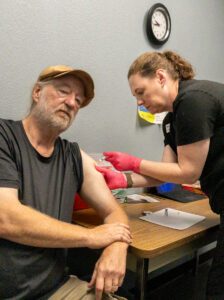
Jennifer Williams, an LVN and clinic manager at the Brownwood/Brown County Health Department Clinic, gives Tony Pilkington his Day 7 rabies vaccination. He received six injections on Day 0, and one each on Days 3, 7 and 14. (Photo by Carla McKeown/Breckenridge Texan)
During our phone call, Williams asked if I had a prescription for the vaccine from my doctor. Everything was happening so fast that I hadn’t realized I needed a prescription and wasn’t sure I could get one quickly. She talked to her medical director, a physician, and arranged for the prescription, so we headed to the clinic in Brownwood.
At the clinic, I got checked in and weighed – because the amount of immunoglobulin they use depends on the patient’s weight.
In the exam room, Williams explained that I would first receive injections of human rabies immunoglobulin (also called immune globulin), or HRIG as it’s called for short, into the bite wounds, with the number of injections depending on how many puncture wounds I had. The remaining HRIG would then be injected into my thighs and one arm.
“We have to put some of that immunoglobulin into every one of those (bite wounds),” she said, explaining that I was about to get multiple needle sticks to flush out the wound and saturate it with immunoglobulin to kill any of the rabies virus that was there.
“So depending upon how many bites and scratches you have, that determines how many needle sticks you get there, and then the remainder has to go into your thighs or into your deltoid, which is in your arm,” Williams said, as I wondered if she realized how much I hate needles. “… we split that up because we don’t want to give you one lump, large amount into one area, because that can cause a knot, so we try to split it up into different locations.”
Depending on the type of exposure to the rabies virus a person has – ranging from no bites or scratches to multiple bites and scratches – they can get anywhere from six or seven injections to as many as 30 or 40.
In my case, I received HRIG injections in the two puncture wounds on my finger, along with one in each thigh and in one arm. I was also given a rabies vaccine that day – that went in the other arm. In total, I received six shots that day — five for immunoglobulin and one for the vaccine.
That was just the first of a total of four vaccinations I would get. Williams explained that the first day’s vaccination is considered Day 0, and subsequent doses would be given on Day 3, Day 7, and Day 14. For me, that was a Wednesday, a Saturday, the following Wednesday and then the Wednesday after that.
She said the Day 0 was the worst part with all of the immunoglobulin injections, and she was right. The follow-up individual vaccine shots weren’t too bad.
And, even at its worst, the treatment was much better than the old regimen of 20 or more shots in the abdomen – and, of course, much better than dying from rabies.
Not easy and not cheap
One of the things that became obvious from my first conversation with Dr. Fambro was that this was not a simple or inexpensive situation. Despite the help from everyone along the way, there were a lot of different aspects to work out.
From getting the deceased kitten to the vet’s office and then Austin to getting myself to a clinic that had the rabies vaccine, there was a lot of travel involved.
And, the treatment isn’t cheap. The cost depends on how much HRIG is needed, but the price can range from about $1,000 to several thousand dollars. Insurance, Medicare or Medicaid may or may not pay for it, depending on coverage, co-pays, deductibles, etc.
Based on information from various state and federal sources, rural Texans have a higher poverty level, are more likely to have to travel longer distances for healthcare, and are more likely to be uninsured than their urban counterparts. After going through all of this, I am worried that there are people living in Stephens County for whom a bite from a rabid animal would carry a heavy burden.
Of course, there is assistance and people who can help come up with solutions, but, still, simply living where we live could be a hindrance to treatment. In an emergency, City or County officials could deliver the specimen to Austin.
One of the goals I want to accomplish with this article, in addition to documenting my experience of getting exposed and treated for rabies, is to provide our readers with information about what to do if it happens to them.
And, that leads us to the next section of this story:
What to do if you’re exposed to rabies
What you need to do if there’s a possibility that you’ve been exposed to rabies depends on several factors, including how you were exposed, what type of animal it was, whether or not you have access to that animal, and other issues. To get more information about what you should do if you may have been exposed to rabies, I interviewed Dr. Kelli Windsor at the Breckenridge Medical Center and later had a formal sit-down interview with Williams at the Brownwood clinic.
All of the experts agree: If you’ve been bitten by an animal or suspect that you’ve been exposed to rabies in any way, you need to call your doctor; one of the Texas rabies depots, such as the health department in Brownwood or Abilene; or the Texas Department of State Health Services.
They will ask for information, such as when and how you were exposed and whether it was a high-risk animal, such as a skunk, raccoon or bat, or a lower-risk animal, such as a cat or dog. Then they will inform you that they need to confirm that the local rabies control authority has been notified and that the case has been reported.
“We give you 72 hours to try to locate that animal because we either want to send it for testing or quarantine it before we have to start treatment … we want to make sure we know what we’re up against,” Williams said. “And then we have to make sure that you see your (healthcare) provider. (They will decide) if you need a tetanus shot, (if) they want you to be treated with antibiotics, if you possibly need stitches or something because it’s a really bad bite or wound.”
Dr. Windsor and Williams agree that anytime someone gets bitten by an animal to the point of puncture or bleeding, they need to be seen by a medical professional. That can be your regular doctor, a doctor or nurse at a medical clinic or a doctor at the emergency room.
“If it’s something that needs more extensive care or needs stitches, or if it’s actively bleeding, then it’d probably be better to go to the ER,” Dr. Windsor said. “But first step is, just wash it out really good, and get the bleeding under control, things like that. So washing it out, putting pressure on it…if it’s bleeding very much, go to the ER.”
One thing to take note of: Dr. Windsor said animal bites or scratches are fairly common. “We have those cases come in the clinic fairly frequently for somebody who’s been bitten by a dog or a cat or scratched,” she said. “It’s usually because they’re trying to break up a fight. So, I would definitely recommend, don’t try to break up a dog fight. … It’s not worth your arm or your finger or whatever it is.”
She said at the clinic or ER, they’ll guide you on what to do, based on the information you provide about the bite, such as the type of incident, whether it was provoked or unprovoked, what the animal was doing, and whether it is a pet, a stray or a wild animal. They will also consider whether the animal was vaccinated and other similar factors.
Everyone I talked to about this said that if it’s a pet or an animal the person has in their possession, it needs to be quarantined for 10 days. If the animal has active rabies that is transmittable, it will die within 10 days, Dr. Windsor said.
She said that during the quarantine period, you need to watch how the animal is acting, and if they are acting completely fine, then it’s fairly reassuring. If the animal starts acting strange or showing the typical rabies signs (see more about that below), then it’s more important for the person to go ahead and get the rabies immunoglobulin and the vaccine.
If you are bitten by a wild animal or an animal that you can’t find and there’s no way to watch them or get them tested, then at that point the experts recommend that you go ahead and do the post-exposure prophylaxis – or preventative treatment – to stop you from getting rabies.
But, Dr. Windsor explained that it doesn’t have to be a bite. One of the things that most people don’t know is that they can be exposed to rabies just through a rabid animal’s saliva, not necessarily a bite or even a scratch, she said.
“So, … if you have a dog you’re trying to restrain or something, and they drool on you, and you have an open sore (or cut) on your finger … just being exposed to the saliva or any bodily fluids could transmit it,” Dr. Windsor said.
Williams also stressed the importance of prompt treatment if you’re exposed to rabies in any way. But at the same time, she said not to panic.
“We don’t want to rush the process, but we want to make sure we do our due diligence so that we’re doing it in a timely manner,” Williams said. “Because rabies is serious – it is deadly – but we have time to stop, slow down, take a breath, and make sure we do it right the first time.”
So, to kind of wrap things up, I asked Williams what advice she had for a patient who just received that phone call informing them that the test for the animal that bit them came back positive for rabies.
“(I’d tell them) that it will be fine (and) to take a breath, that we’ve been doing this, us specifically, and, in general, healthcare has been dealing with rabies for many, many, many years, and that it will be fine,” she said. “We just take the steps that we have to take, get the treatment, and it will be fine.”
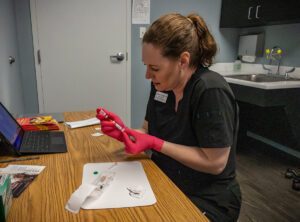
Jennifer Williams, an LVN and clinic manager at the Brownwood/Brown County Health Department Clinic, prepares one of the injections for Tony Pilkington’s rabies treatment. (Photo by Tony Pilkington/Breckenridge Texan)
Treatment options
Williams explained that when treating patients, they follow the protocol and take advisement from the state’s rabies experts.
In addition to the Brownwood clinic, Williams said, there are other options for getting the treatment. She mentioned that most emergency rooms, like Hendrick Medical Center in Abilene, have the vaccine available and can provide the treatment; however, many small-town emergency rooms do not keep the vaccine on-hand.
She added that many doctors’ offices don’t have it because it’s expensive and most don’t keep it in stock. As an official Texas Rabies Depot, the Brownwood clinic always has the treatment available.
“So the state… they’ll send us as much as we want,” Williams said. “And so, we try to keep an abundance on hand because we never know when we’re going to need it.”
Since the rabies vaccine is not available over the counter, a prescription from a physician is needed. “We need a prescription to be able to start your treatment, but we have a 10-day window from the date of exposure to get you started on treatment, so we have a little bit of time,” she said.
Although most small-town clinics or hospitals don’t keep the rabies vaccine on hand, driving to Brownwood, Abilene or Wichita Falls for the follow-up shots (on days 3, 7 and 14) may not be necessary for Stephens County residents. Williams said the Brownwood clinic will coordinate with a patient’s primary physician and provide the vaccine to them so that a patient can get the follow-up treatments closer to home. Dr. Windsor confirmed that the Breckenridge Medical Center can work with the rabies depots to arrange for local treatment.
However, Williams said, oftentimes the patients and their healthcare providers prefer that they continue the treatment at the rabies depot, since the staff there handles rabies cases regularly.
In my case, for example, I found it to be simpler and a more seamless process to continue my treatment in Brownwood.
Prevalence
Williams said the number of rabies cases the clinic handles each year varies. “They kind of go through seasons,” she said. “It kind of depends on the mating season, depends on the weather. We never know. We can see three in one week, and we can see three in a month. We don’t know.”
She said that in their 2023-2024 fiscal year, which runs from October to September, the Brownwood clinic treated 48 patients, an average of almost one case a week. Since January of this year, they have had 33 cases.
Additionally, she said the types and ages of patients they’ve treated vary, from as young as three weeks to as old as 92. Likewise, the types of animal bites they’ve handled differ. “We’ve seen (bites from) cats and dogs and bats and skunks and raccoons and foxes, and we’ve seen exposures to all of it,” she said.
Understanding Rabies
Rabies is a frightening and deadly disease, and the more I read about it while researching this article, the scarier it seemed. But it’s also highly preventable and can be treated in humans exposed to it, provided they receive timely treatment after exposure.
Dr. Fambro, who is the rabies control officer for Stephens County and has seen more than his share of rabies cases and been exposed to it multiple times himself, told me there are three types of rabies: dumb rabies, furious rabies and what is called atypical rabies.
Furious rabies, or encephalitic rabies, affects the brain, causing extreme hyperactivity, agitation, and behavioral reversals where wild animals lose their fear of humans. It is sometimes accompanied by a distinct vocal change and foaming at the mouth due to an inability to swallow.
Dumb or paralytic rabies instead triggers progressive paralysis starting from the bite site, causing a dropped jaw, choking reflexes, extreme lethargy, and a loss of coordination that lead to a fatal coma.
Atypical rabies, or non classic, doesn’t fit into the other categories. Instead, it shows erratic shifts between excitation and depression, localized paralysis rather than widespread, and temporary digestive or respiratory symptoms that mask underlying neurological deterioration.
“I don’t know that I’ve ever seen an atypical, but I’ve seen dumb rabies, and I have seen furious rabies,” Dr. Fambro said.
In all three types, once symptoms appear, the disease is considered to be always fatal.
After talking to Dr. Fambro, I was curious to see how many people die each year from rabies. So I did a quick web search, and I was shocked. According to the World Health Organization, rabies is estimated to cause 59,000 human deaths annually across more than 150 countries, with 95% of cases occurring in Africa and Asia. Due to widespread underreporting and uncertain estimates, this number is likely a significant underestimate of the true burden of the disease. Ninety-nine percent of rabies cases are dog-mediated, meaning that most cases of rabies in humans are caused by dogs. Additionally, the disease disproportionately affects poor, rural populations, with about half of the cases involving children under 15, according to the WHO.
That’s a staggering number for a disease that most of us here don’t give a second thought to in our daily lives, at least until we read a news story about somebody getting bit or, like in my case, actually getting bitten by a rabid kitten. Fortunately, in the United States, human deaths by rabies are rare. According to the CDC website, each year 1.4 million Americans receive healthcare for a possible rabies exposure, 100,000 receive post-exposure prophylaxis, and fewer than 10 die from rabies due to robust prevention efforts.
However, as mentioned earlier, survival depends on treatment. It doesn’t take much looking online to confirm that rabies has a very high fatality rate in humans. According to an article on the Oxford Academic website in October 2025, worldwide, there have only been about 34 well-documented survivors, which it defined as survival at 6 months after onset of clinical rabies. However, many survivors suffered from serious, lifelong neurological damage, and many of the survivors had received the vaccine in the past. So, yes, rabies is frightening and extremely dangerous.
There are different strains of the rabies virus, and in Texas, Dr. Fambro said, the skunk is the natural reservoir – or host – for rabies. Around Austin, bats with rabies are more common, but the different strains can be found here, too.
“In fact, a few years ago I had a lady bitten by a bat in Albany, and it turned out positive,” he said. “And there are different strains — bat rabies, skunk rabies, fox rabies. Up north, in the northeastern part of the United States, it’s mainly the fox, from what I’ve been told. But around here, in north-central Texas, it’s the skunk.”
Rabies only affects mammals and not reptiles, and some animals are more prone to infection, while others, like opossums, seem to be less likely to have rabies.
Although the only sure way to determine whether an animal has rabies is to send its head to a rabies lab for testing, Dr. Fambro said there are outward signs to look for that may indicate an animal is rabid.
For example, he said a rabid skunk will look wobbly when it walks and act incoherent. A skunk simply being out and about during daytime hours isn’t enough to warrant concern, Dr. Fambro said, but a skunk that doesn’t act like a normal skunk is a problem.
According to the Texas Department of State Health Services, the following are clinical signs of furious and dumb rabies:
- In the furious variety, the “mad dog” symptoms are pronounced. The animal is irritable and will snap and bite at real or imaginary objects. It may run for miles and attack anything in its path. The animal is extremely vicious and violent. Paralysis sets in shortly, usually affecting the hind legs first. Death follows four to seven days after the onset of clinical signs.
- In dumb rabies, the prominent symptoms are drowsiness and paralysis of the lower jaw. The animal may appear to have a bone lodged in its throat, sometimes causing owners to force open an animal’s mouth to investigate and become unwittingly exposed to rabies. Animals with dumb rabies have no tendency to roam but will snap at movement. They are completely insensitive to pain, and usually become comatose and die from three to ten days after first symptoms appear.
Not all animals that act unusual have rabies, Dr. Fambro said. Other things, such as encephalitis and canine distemper can have symptoms that might seem similar to rabies.
Overall, he recommends staying away from wild animals and strays.
Contacting the authorities
If you have been bitten by an animal, not only should you seek medical attention, but you also need to report the bite to local officials. You can call the non-emergency dispatch number for the Stephens County Sheriff’s Office or the Breckenridge Police Department at 254-559-2211. In the case of an emergency, call 9-1-1.
When it comes to animal bite calls, the Sheriff’s Office usually handles calls in the rural parts of Stephens County and the Breckenridge Police Department deals with cases in the city limits.
Sheriff Kevin Roach said how a call is handled really depends on the circumstances.
Roach said typically they advise people to seek medical advice from their health professional. “We always err on the side of caution and treat everything like it is rabid, whether it is or not,” he said.
The sheriff said if there’s a dog bite outside the city limits, they contact Dr. Fambro, since he’s the animal rabies control authority in Stephens County. If the dog is vaccinated for rabies, Roach said Dr. Fambro will allow a home quarantine. But if it’s not vaccinated, they will take it to the Breckenridge animal shelter and quarantine it for 10 days to make sure it’s not rabid.
He said that since the county does not have a quarantine facility, they use the City of Breckenridge’s animal shelter facility because it is the only authorized rabies quarantine facility in the county.
Breckenridge Police Chief Blake Johnson, who also oversees the city’s animal control department, said the city’s policy when responding to dog bite cases is similar to the county’s – quarantine the dog at the city animal facility for 10 days.
He likewise said the City consults with Dr. Fambro on such situations.
But, being bitten by an animal isn’t the only time you should call the authorities; if you see an animal that you think might have rabies, call the sheriff’s office to report domesticated animals in rural areas of the county, the police department for domesticated or wild animals within the city limits and the game warden (or the sheriff’s office) for wild animals in the rural areas of the county.
Since he’s been sheriff, Roach said, they’ve had some suspected rabies cases with wildlife but not with domesticated animals.
He said the last animal call he had was a few weeks ago about two skunks at the lake. He said he responded to the call because the game warden in the area was busy with another call. Typically, he said, if a wild animal hasn’t bitten a person or domestic animal, they don’t send them off for testing.
“So we go out and evaluate the wild animal, and if its behavior is indicative of being rabid, then we’ll just put it down and then destroy the carcass where other wildlife can’t get exposed to it,” he said.
Johnson said the city gets quite a few wildlife calls in the city limits because this is a rural area in general. He said they will respond to any calls for service but that the problem is they’re not “wildlife control.”
Johnson said the City just doesn’t have the resources to deal with every wild animal that makes its way into the city if it’s not deemed to be a public safety issue.
“Our first saying is to… just leave them alone,” he said. “If they start showing distress to the point where it seems like it could be rabies, then obviously putting down the animal is an option, which (officers) would do… If it’s out during the day, a lot of times, you know, we will certainly try to put it back towards … the wild.
Importance of Vaccinating Pets
The solution to preventing most of the rabies problems that Breckenridge and Stephens County – and even the United States – experience is getting pets vaccinated.
When it comes to vaccinating pets, Dr. Fambro said pet owners are good about getting their dogs vaccinated, but not so much with their cats. He emphasized that rabies is a highly preventable disease, and vaccinating pets for rabies is about protecting humans — the pet owners — just as much as the pets. “You are building a protective wall against you and the rabies virus,” he said.
He said the cost of vaccinating your pets is a small price compared to the protection it offers you and your pets, as well as the costs you face for rabies treatment if you do get exposed.
In the City of Breckenridge, dog owners are required to get their dogs that are 4 months old or older vaccinated for rabies by a licensed vet, get them a booster every year, and keep the paperwork to prove that the dog has been vaccinated.
Although the City doesn’t have a law requiring that cats be vaccinated and Stephens County doesn’t have a local vaccination law in place, the state of Texas requires that dogs and cats be vaccinated against rabies by 4 months of age and then receive boosters every 1 or 3 years, depending on the vaccine they receive. The vaccination must be administered by a licensed veterinarian. So, based on the Texas law, every cat and dog in Breckenridge and Stephens County should be vaccinated against rabies.
In my specific case, the kitten was less than 4 months old and wasn’t eligible for the vaccination. Since the mama cat just showed up at our house not long before the kittens were born, we had no idea if she had been vaccinated.

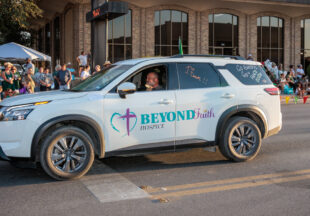
On Monday, July 6, the Stephens County Humane Society will host a low-cost, drive-through rabies vaccination clinic at the Breck Trade Days Office in the city park. (Photo by Tony Pilkington/Breckenridge Texan)
Community Drive-through Clinic
On Monday, July 6, the Stephens County Humane Society will host a low-cost, drive-through rabies vaccination clinic at the city park.
The clinic will be from 5:30 to 7 p.m. in the 500 block of East Hullum, at the red brick building (the Breck Trade Days Office, next to the sand volleyball court and across the street from the Trade Days Barn). The rabies shots will cost $10 per animal for dogs and cats. No other exams or shots will be offered at that time.
All cats must be in a pet carrier or otherwise contained, and all dogs must be on a leash. The Humane Society asks that anyone bringing a dog that is not good with other animals, muzzle the dog while they are at the shot clinic.
“Dog owners can keep their dogs in their cars to get vaccinated, or they can take them out of the car if they prefer. However, all dogs must be on a leash, even if they are inside the car,” said Kathy O’Shields, president of the Stephens County Humane Society. “Last year we just did them at the car, it was easier.”
She said the cats will be taken into the building to get the shots. “We’ll take the cats into the building. I don’t trust doing it in the car. Cats … get too scared,” she said.
To receive the vaccinations and the certificate of vaccination, owners must fill out an information sheet. The event will be open to all Stephens County residents.
Lessons Learned
Overall, this has been an expensive, time-consuming and extremely stressful situation. And, that is with all of the help and patience of the experts and authorities I’ve been dealing with.
The main lessons I’ve learned from this and hope that others will learn by reading about my experience:
- Get your pets – or even any strays that you have access to – vaccinated against rabies. Even though the kitten that bit me was too young for a vaccination, we had let our other cats’ vaccinations lapse, and that added more stress. We’ve fixed that situation now.
- Pay attention to wild animals near your home. Not long before that kitten died, we had seen a skunk walking down the driveway. It wasn’t exhibiting obvious signs of rabies, but it was just a little odd. When I went to look for it again, it was gone and was likely the one killed out on the highway a short time later. Looking back, there’s a good chance that skunk had tangled with the kitten and was the source of the rabies.
- Take animal bites serious. I didn’t go to a doctor for the initial bite, opting to just bandage the wound at home. That probably wasn’t the smartest choice. I’m glad that we found the deceased kitten quickly and were able to get the body to Dr. Fambro in a timely manner.
- Practice extreme caution around animals, especially strays and/or animals that are fighting.
- Seek help as soon as you can and trust the advice of medical professionals and other experts.
Cutline, top photo: After being bitten by “barn cat” kitten that turned out to have rabies, Tony Pilkington had to undergo treatment for the deadly virus. (Self-portrait by Tony Pilkington/Breckenridge Texan)
Carla McKeown, Breckenridge Texan editor and Tony Pilkington’s wife, contributed to this article.
Related Article:
Stephens County kitten tests positive for rabies