No screwworm cases reported in Stephens County; online informational meeting scheduled for Tuesday, June 23
By Tony Pilkington/Breckenridge Texan
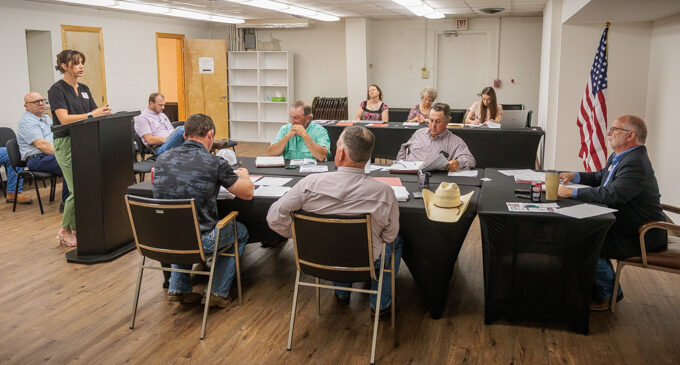
Although several cases of New World screwworm have recently been confirmed in Texas, there are no known cases in Stephens County, AgriLife Extension Agent Jessie Shortes said during her update to Stephens County Commissioners at their meeting this morning, Monday, June 22.
There are several upcoming opportunities for livestock producers, landowners and wildlife managers to get more information about the invasive livestock pest, including an online educational meeting Tuesday morning and an in-person program in Brownwood on Wednesday.
“I do want to reassure everybody right now that New World screwworm has not been detected in Stephens County or any surrounding counties,” Shortes told commissioners.
According to Shortes, Texas currently has 15 confirmed cases of New World screwworm, although three of those cases are now considered inactive. The U.S. Department of Agriculture website updates case information daily and shows that the currently active cases are in the following Texas counties: Tom Green, Crockett, Edwards, Zavala, Gillespie and La Salle.
Shortes said state and local officials have been preparing for the pest’s arrival for more than a year. She hosted a screwworm educational program in Stephens County in June 2025 as part of those preparations.
Despite its name, the New World screwworm is not a worm but a fly. The pest poses a threat to livestock, including cattle, goats and sheep, as well as wildlife, because its larvae feed on living tissue rather than dead tissue.
“The maggots do not feed on dead tissue; they do feed on live animals and, if left untreated, can cause a lot of damage to your animals and or death,” Shortes said.
She said producers who regularly inspect livestock should be able to identify infestations early and treat the affected animals. There are several over-the-counter and veterinarian-prescribed drugs available to help treat infected animals. Information on approved treatments and reporting procedures can be found through the Texas A&M AgriLife Extension website stephens.agrilife.org.
Shortes said that suspected cases must be reported and confirmed through laboratory testing. Samples must be collected from deep within an animal’s wound because other fly species can also deposit larvae in open wounds.
“You do have to actually retrieve maggots out of that wound, not off the surface, but deep in the wound, because other flies will lay their eggs in those wounds as well,” she said. “If you call me in my office, I’ll come out and help take that sample. Now, you do need to be present.”
The state’s primary response strategy relies on the release of sterile flies in areas where infestations are confirmed. Because female screwworm flies lay eggs only once in their lifetime, the sterile insect technique has historically been effective in reducing populations.
“How we fought it back in the ’60s and ’70s and eradicated it and how we’re fighting it now is with a release of sterile flies,” Shortes said. “In order to get sterile flies to your county…you have to have a confirmed case.”
County Judge Will Thompson asked whether a disaster declaration would be necessary if a confirmed case occurs locally. Shortes said county officials, the USDA and her office would coordinate response efforts if the pest is detected in Stephens County or neighboring counties.
Shortes said confirmed Texas cases have involved primarily cattle, along with a small number of sheep, goats and one dog. The dog case involved an animal that had traveled into Mexico and was later treated.
While no transportation restrictions currently apply to livestock, she encouraged producers to closely monitor their animals and report suspicious wounds or infestations.
“The big thing here in Stephens County, and what I’m asking producers to do, is please look at your animals. If you see something, report it,” she said.
Shortes also advised ranchers to consider management practices that reduce exposure to flies if the pest reaches the county, including scheduling activities such as tagging, castrating and calving during cooler months when possible.
“It’s very hard to do for most of us,” Shortes said, referring to changing production schedules. “So that is why we’re trying to take precautions.”
Statewide Virtual Meeting
At 9 a.m. Tuesday, June 23, the Texas A&M AgriLife Extension Service in Montague County will host an online educational meeting for livestock producers, landowners and wildlife managers, focused on the New World screwworm.
The virtual meeting will be held via Microsoft Teams. Organizers say the session is designed to provide timely information about the biology of the pest, prevention strategies, and best management practices for producers in the region. The program is intended to help producers and land managers better understand the threat and what steps to take if cases are suspected.
The meeting will cover several key topics, including:
- How the New World screwworm spreads
- General livestock management practices
- Wildlife monitoring and surveillance considerations
Participants will also have the opportunity to learn practical strategies for maintaining herd health.
The session will be conducted entirely online using Microsoft Teams, and participants can join in one of two ways:
- Join by direct link: Click this link and follow the prompts.
- Join using Meeting ID: 275 071 149 431 328 and Passcode: u84hq3qX
Participants may join from a computer, tablet or smartphone. No Microsoft Teams account is required; users can select the option to join through a web browser. Attendees are encouraged to log in a few minutes early to ensure their device audio and video are working properly.
More information, and fact sheets, can be obtained at the Texas A&M Agrilife Extension website: https://agrilifeextension.tamu.edu/new-world-screwworm
The program is hosted by the Texas A&M AgriLife Extension Service, which continues to provide research-based education and outreach to agricultural communities across Texas.
Brown County Meeting
On Wednesday, June 24, the Brown County AgriLife Extension Service will host the “Heart of Texas: New World Screwworm & Pasture Mealybug Update” from 5 to 7 p.m. at the Adam Street Community Center, 511 E. Adams St. in Brownwood.
The program will feature updates on the New World screwworm from Dr. Sonja Swiger, Texas A&M AgriLife Extension entomologist, and Dr. Dustin Dorris of the Texas Animal Health Commission.
A presentation on pasture mealybugs, titled “A New Invasive Pest in Pastures and Hayfields,” will be given by Greg Wilson, Extension Program Specialist for Integrated Pest Management.
Topics will include the current New World screwworm situation and surveillance efforts, identification and reporting procedures, livestock producer prevention and management practices, pasture mealybug biology and spread, identification of infestations in hayfields and pasture, and Integrated Pest Management recommendations.
The event is free to attend. Two continuing education units have been approved, including two IPM CEUs. Attendees are asked to RSVP through the Brown County Extension Office at 325-646-0386. Refreshments will be provided.
Cutline, top photo: Stephens County Extension Agent Jessie Shortes, left, talks to the Stephens County Commissioners at their Monday, June 22, meeting about the New World screwworm situation in Texas. (Photo by Tony Pilkington/Breckenridge Texan)