Stephens County to hold three public hearings on Monday for tax rate, budget, and salary increases for elected officials
The Stephens County Commissioners Court will hold three public hearings, in addition to the regular county meeting, on Monday, Sept. 28. The public hearings will include the proposed budget, proposed salary increases for elected officials and the proposed tax rate, which was rescheduled on Sept. 14 due to concerns about required public notices. At the Sept. 14 meeting, the commissioners also took care of other County business.
Next Monday’s meeting is scheduled to begin at 9 a.m. in the Stephens County Annex Building, located at 222 N. Baylor Ave. Click here to see the full agenda.
The public may speak during any or all of the public hearings, as well as during the public comments section of the meeting or during the discussion on individual agenda items. Anyone who wants to speak at the meeting must fill out the Public Participation Form (click here to download a copy of the form) and submit it to the County Commissioners’ clerk in person at the County Judge/Commissioners’ office (room 115 in the Stephens County Courthouse at 200 W. Walker St.), via email at commissioners@stephenscountytx.gov, or in person on the day of the meeting – prior to the start of the meeting. Each person speaking is limited to 5 minutes during each public hearing and 3 minutes on other agenda items.
Following each of the hearings, the commissioners are scheduled to vote on the specific items, tax rate, county budget and salary increases for the elected officials.
Tax Rate Public Hearing
The public hearing on the tax rate will offer the community a chance to voice their opinions on the proposed tax rate for the 2026 tax year, which is $0.658000 per $100 property valuation.
That rate is lower than the current rate of $0.665390. However, because of the increase in local property values, the proposed tax rate ($0.658000 per $100) is 8.44% higher than the no-new-revenue tax rate. Every year, the State of Texas requires taxing entities to calculate the tax rate that they would need to charge to raise the same amount of revenue as they did in the previous year, taking changes in property values into consideration. With the higher property values in Stephens County, the no-new-revenue rate is $0.606769 per $100.
Because the proposed rate is more than the no-new-revenue rate, the County is required to hold the public hearing. However, the proposed rate is lower than the “voter-approval tax rate,” which is $0.658700 per $100. Because the proposed rate does not exceed the voter-approval tax rate, an election is not required.
Although every homeowners property tax amount will be determined based on their specific property value, the average property value will likely be increased this year. As an example, the County reports that the average homestead taxable value has increased from $123,116 in 2025 to $141,069 in 2026. That means the tax on an average homestead is expected to go from $743 to $841, an increase of $98. The total tax levy across all properties is proposed to rise from $6,138,684 to $6,460,824, an increase of $379,794.
Click here to see the public notice regarding the tax rate and the public hearing.
In addition to speaking at the meeting, local citizens may express their opinions about the proposed tax rate by contacting members of the Stephens County Commissioners Court at 254-559-2371. For assistance or additional details, the Stephens County Tax Assessor can be contacted at 254-559-2732, by email at c.shook@stephenscountytx.gov, or online at co.stephens.tx.us.
Note: A public hearing regarding the tax rate was scheduled for the Sept. 14 County Commissioners meeting. However, some concern about the public notice requirements prompted the commissioners to schedule another public hearing on Sept. 28.
County Budget Public Hearing
Also during the Sept. 28 meeting, the county commissioners will hold a public hearing on the county’s proposed Fiscal Year 2027 budget, which covers the fiscal year beginning Jan. 1, 2027, and ending Dec. 31, 2027.
The proposed budget will raise more total property taxes than last year’s budget by $379,794, or 7.05%. Of that total increase, $155,666 is tax revenue to be raised from new property added to the tax roll this year, according to the official notice (click here to see the notice).
Click here to see the full, proposed budget.
Salary Increases Public Hearing
The meeting also will include a public hearing regarding proposed increases to the salaries, expenses, and allowances of elected county and precinct officers for Fiscal Year 2027.
Under the proposed budget, most elected officials — including all four county commissioners, the county attorney, county clerk, district clerk, county treasurer, tax assessor-collector and justice of the peace — are slated for a $3,400 annual salary increase, raising their base pay from $54,600 to $58,000. The sheriff’s salary is also proposed to increase by $3,400, moving from $57,876 to $61,276.
The county judge’s salary will remain unchanged at $58,000, though his annual vehicle allowance is proposed to decrease by $400, from $10,000 to $9,600. Vehicle allowances for the four Commissioners ($12,600 each) and the Justice of the Peace ($3,600) will remain at current levels.
Click here to see the public notice, which includes the salaries and proposed increases.
Funds for Rodeo Association
In a 4-1 vote, the county commissioners voted to drop a previously tabled motion regarding a $50,000 funding request from the Stephens County Rodeo Association, opting instead to revisit the request during the court’s overall non-profit fund allocations in October. Commissioner Will Warren cast the lone dissenting vote.
The decision came during a discussion in the Sept. 14 meeting regarding the allocation of PILOT (payment in lieu of taxes) funds that Stephens County will receive annually from NextEra as part of the windfarm agreement. The rodeo association has requested $50,000, though the court had previously agreed to give them $25,000 out of the $75,000 PILOT funds. County Judge Will Thompson and County Attorney Trammell noted that while county tax money cannot be promised year-over-year to an entity due to legal restrictions, PILOT funds are private funds that can be designated by the county.
The commissioners debated both the oversight of the funds and the proportion of the request. Commissioner David Fambro voiced support for the rodeo’s economic impact, stating that nothing the court has done has brought more business into Stephens County. However, Fambro and Commissioner Mark McCullough expressed concern that allocating $50,000 would take up 66% of the county’s $75,000 total pool, leaving only $25,000 for other local non-profits. Fambro also expressed a desire to see reports on how the money is spent, though Warren asserted that the association had previously presented plans and reports to the court.
The court also examined legal and practical limits on multi-year commitments, with the commissioners and others noting that they cannot make decisions for future courts, making a two-year commitment the maximum feasible arrangement.
While Warren expressed readiness to commit to the funding immediately, Fambro and Thompson suggested dropping the current motion and re-addressing the request in October when the court formally designates and distributes its $75,000 in funds to qualified non-profits.
Fambro made the motion to drop the item and revisit it during the October allocation process, which was seconded by McCullough. The final vote recorded was: For the motion: Commissioner Fambro, Commissioner McCullough, Commissioner Wade, and Judge Thompson. Against the motion: Commissioner Warren.
Flock Cameras
At the Sept. 14 meeting, the commissioners unanimously voted to authorize Stephens County Sheriff Kevin Roach to enter into a multiple-use agreement with the Texas Department of Transportation, allowing the installation and operation of automated license plate recognition (or “reader”) cameras in the TxDOT right away.
Earlier this year, the commissioners approved Roach to apply for a grant for the cameras. At that time, he said he was looking at purchasing cameras from the Flock Safety company.
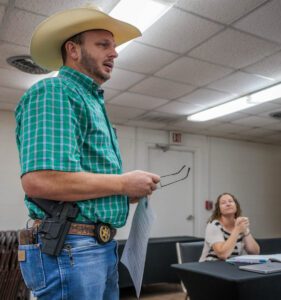
Stephens County Sheriff Kevin Roach talks to the county commissioners about the automated license plate readers that he is planning to have installed around the county. (Photo by Tony Pilkington/Breckenridge Texan)
Last week, Roach said he had entered into agreements with everyone except for TxDOT and that he needed additional approval from the commissioners for that. He said everything is on schedule but that it will be several more months before the system is implemented.
The commissioners approved the agreement with TxDOT.
At a county commissioners meeting in March, Roach requested authorization to pursue and apply for an 80/20 Motor Vehicle Crime Prevention grant to fund the ALPR cameras. He said that the system will help deputies investigate and solve crimes — such as property crimes, stolen vehicles, burglaries, drug trafficking, human smuggling, illegal dumping, and missing person Amber or Silver Alerts — by reading “vehicle fingerprints” rather than identifying drivers or passengers. At the time, he said the proposed initial phase would implement 16 cameras stationed at major entry points on paved roads leading into Stephens County, as well as at key highway splits like State Highway 67 and U.S. Highway 180, to immediately track and alert law enforcement to stolen vehicles or suspects entering or leaving the area.
“We would implement policies restricting that use, but it’d be authorized law enforcement, and part of the policy would be record retention on who accesses it and a legitimate reason why,” Roach told the commissioners in March.
He emphasized that the cameras are not designed to identify drivers or passengers. “They’re looking at vehicle fingerprints only,” Roach said. “I went through a little display with the sales guy … I was looking at illegal dumping, (and) he was able to put in, ‘white pick-up truck hauling mattresses,’ and it picked up every vehicle like that. In the grid he was looking on, you can see a vehicle with mattresses in it, but there’s no driver or passenger. It’s not looking for people. It’s looking for vehicles. But, you can put in ‘a red truck-tractor hauling gravel,’ and it’s every one of them that are red, that are hauling gravel.
“And it’s instantaneous. There’s no lag,” he continued. “So it would be a network sharing. I mean, they have over 10,000 cameras in the state of Texas, and anybody that has access to the system can look anywhere in the state.”
Roach told the commissioners in March that Stephens County could not afford the technology without grant assistance, noting that the total cost for 16 cameras under a three-year contract is $154,400, with individual cameras costing roughly $3,000 annually plus potential TxDOT-dependent installation fees ranging from $1,500 to $2,500 each. However, if approved for the 80/20 reimbursement grant — which requires the county to pay upfront before receiving 80% reimbursement — the county’s portion would be reduced to just over $30,000.
“I love the idea of it, but I don’t know how in the world we could ever pay for that every year,” Precinct 3 Commissioner Will Warren said.
Addressing the long-term funding concerns, Roach suggested that future costs could potentially be covered by reallocating money previously budgeted for patrol vehicles, as Senate Bill 22 rural law enforcement grant funds are currently covering 100% of patrol vehicle purchases, or by exploring whether Senate Bill 22 funds could directly cover the county’s matching portion under officer safety guidelines.
On March 23, the commissioners approved his request to pursue the grant for the cameras.
Other business
At the Sept. 14 meeting, the commissioners also took the following actions:
- Voted to allow County Commissioners who want to get a county credit card in their name for purchases for their precinct to do so.
- Agreed to purchase two ambulances using grant money through Texas House Bill 3000, which established the Rural Ambulance Service Grant Program to help eligible rural counties fund ground ambulances, necessary equipment, and vehicle modifications. The ambulances will be used by the local Sacred Cross EMS team to provide emergency services to the community.
- Approved the annual financial audit, which Thompson said had been presented to the commissioners in a previous workshop
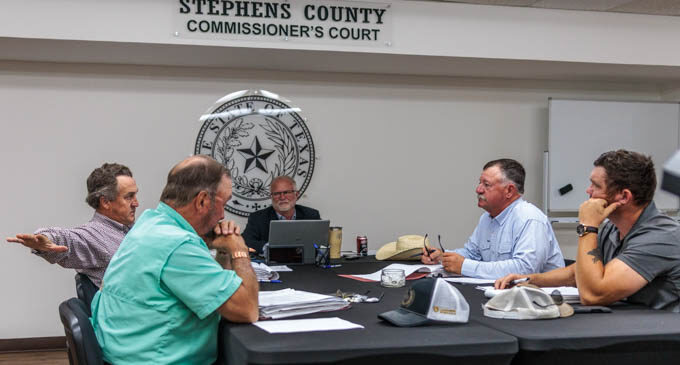
Cutline, top photo: The Stephens County Commissioners talk about a request for funding from the Stephens County Rodeo Association during their Sept. 14 meeting. Pictured, from left, are David Fambro, Precinct 1; Mark McCullough, Precinct 2; County Judge Will Thompson; Will Thompson, Precinct 3; and Tanner Wade, Precinct 4. (Photo by Tony Pilkington/Breckenridge Texan)