Stephens County unveils ‘Alamo Letter’ monument, celebrates courthouse’s 100th anniversary
By Carla McKeown/Breckenridge Texan
A little more than 190 years ago, Lt. Col. William Barret Travis sat in an abandoned church-turned-fort in what is now known as San Antonio and penned a letter that was read around the world and is still taught to Texas school children in their history classes.
The letter, which is commonly referred to as the “Alamo Letter,” the “Victory or Death Letter” or the “Travis Letter,” asked for reinforcements to help the 157 Texans – sometimes called Texians – who were facing thousands of Mexican soldiers. Travis wrote the letter on Feb. 24, 1836, and sent Capt. Albert Martin to deliver it to Sam Houston, who was, at that time, the commander-in-chief of the Texas Army.
“The enemy has demanded a surrender at discretion, otherwise, the garrison are to be put to the sword, if the fort is taken – I have answered the demand with a cannon shot, & our flag still waves proudly from the walls – I shall never surrender or retreat,” Travis wrote.
He closed out the letter with the words “Victory or death,” which he underlined three times.
When Martin got to the town of Gonzales, he handed off the letter to a fellow courier, Launcelot Smither, who took it to San Felipe de Austin, and from there it was reportedly delivered to Washington-on-the-Brazos, where Houston and other delegates were gathered to draft the Texas Declaration of Independence. Along the way, the letter was copied, and newspapers started publishing the text of the letter, sharing Travis’ plea for help with the state. Eventually, the letter was also reproduced in newspapers outside of Texas.
Only a little help showed up – 32 men on March 1 – and on March 6, 1836, the Mexicans defeated the Texans at the Alamo with most of the men killed in battle or executed afterwards. Despite the loss, the dedication conveyed in Travis’ letter and the courage of the Texans at the Alamo inspired other Texans to continue the fight for independence.
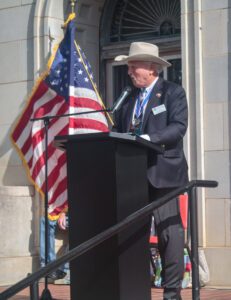
Ken Raney, Stephens County co-chair of the Alamo Letter Society, welcomes guests to the unveiling of the Alamo Letter monument on the lawn of the courthouse. (Photo by Carla McKeown/Breckenridge Texan)
On Tuesday, April 14, 2026, a crowd gathered on the courthouse lawn in Breckenridge as Stephens County became the 37th Texas county to install a bronze replica of the letter. The ceremony also celebrated the 100th anniversary of the Stephens County courthouse, which was built in 1926.
Led by Ken and Carolyn Raney, the Stephens County co-chairs for the Alamo Letter Society, the ceremony included local officials and citizens, representatives from around the state, and Errol Flannery, the fourth-great-grandson (great-great-great-great-grandson) of Davy Crockett, the American frontiersman and politician who made his way to Texas and defended and died at the Alamo.
Carolyn Raney is the past president general of the Daughters of the Republic of Texas, and Ken Raney is the treasurer general of the Sons of the Republic of Texas. They live in the Dallas area but have property in southwestern Stephens County, which they visit frequently.
“Today, we celebrate the 100th anniversary of our beloved courthouse and the dedication of a monument to the most important letter in Texas history, William Barret Travis’ February 24, 1836, letter from the Alamo,” Ken Raney said, welcoming guests to the event.
Following a prayer by First Baptist Church preacher Andy Rodgers, Stephens County Veterans Service Officer Les Strickland and Wayne Chapman presented the colors, and Judy Wolfe, president of the Picketville Chapter of the Daughters of the Republic of Texas, led the U.S. and Texas pledges.
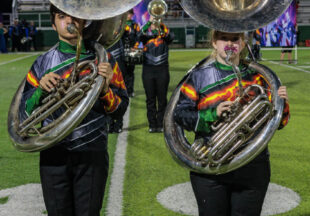
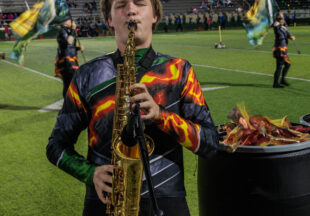
The Breckenridge High School marching band played the National Anthem and other patriotic songs, and Raney recognized representatives from Sen. Phil King and Sen. Ted Cruz’s offices.
Stephens County Judge Michael Roach introduced former County Clerk Helen Haddock, who read a poem titled “The County Courthouse,” which includes the line “Here you will find the county judge, treasurer, the sheriff, the JP, the county attorney, tax assessor and the county and district clerks. It’s America’s best example of how grassroots democracy works.”
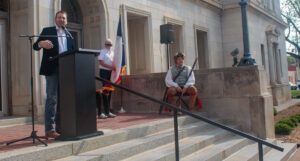
Stephens County Judge Michael Roach spoke briefly about the history of the courthouse, which was built in downtown Breckenridge 100 years ago. (Photo by Carla McKeown/Breckenridge Texan)
Roach spoke briefly about the courthouse and some of the progress that’s been made in the past 100 years, especially in regards to civil rights. “If you look where we’ve come in the last 100 years, local government, I’m kind of fond of local government…it’s really where the rubber meets the road for citizens. And so, for all the elected officials that have come before and are here now, thank you for 100 years,” Roach said. “We look forward to what all God’s going to do in the next 100 and hopefully it’s all in the right direction.”
Then, Raney told the story of how, in 2023, Bill McNutt and his family were visiting the Alamo. When they were looking at the bronze plaque that features the Travis letter, his youngest daughter, Sloane, asked him why there weren’t plaques like that all over Texas. From that idea, McNutt recruited Rosser Newton and John Vick, and the three formed the nonprofit organization the Alamo Letter Society with the mission of placing bronze plaques featuring Travis’ letter at all 254 Texas county courthouses.
“And so I’m happy to tell you today that we’re number 37,” Raney said. “…on Monday, February 24, 2025, at 10 a.m., I first presented the application for the county commissioners to think about on the 189th anniversary, to the day, of this particular letter. And I can tell you that it was unanimously approved.”
Raney went on to explain that the date on the plaque is 2025 because that’s when the plaque was approved and created; however, it took about a year for Raney and Stephens County to get the granite base that the plaque is displayed on.
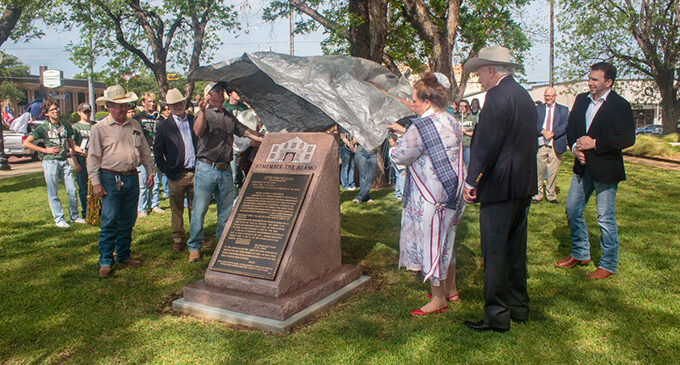
Up until that point during Tuesday’s ceremony, the plaque had been covered with a tarp. Raney was joined by his wife, Carolyn Raney; Michael Roach; Errol Flannery; incoming County Judge Will Thompson; and Stephens County Commissioners, David Fambro, Mark McCullough and Tanner Wade, in unveiling the plaque.
Then, Flannery, dressed as his ancestor Davy Crockett, gave a dramatic reading of the letter, as it might have been presented to the Texans at the Alamo 190 years ago. “Gather round boys. Our commander has just written a letter. It’s to be going out by courier this very day, and he’s asked me to read it to you before it goes,” he said, before reading the words Travis penned.
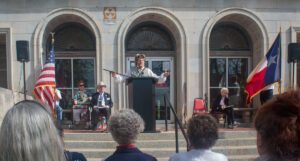
Errol Flannery, the fourth-great-grandson of Davy Crockett (great-great-great-great-grandson), presents a dramatic recitation of the letter written by William Barret Travis, asking for help in defending the Alamo. (Photo by Carla McKeown/Breckenridge Texan)
Following his recitation of the letter, Flannery presented the Raneys with the Captain Albert Martin Award on behalf of the Alamo Letter Society. Martin not only delivered the letter to a fellow courier, but he also added two postscripts to the letter strongly encouraging help for the Alamo. Then, he returned to the Alamo with the few men who were able to answer the call for reinforcements. Martin, like the others, died at the Alamo just five days after his return.
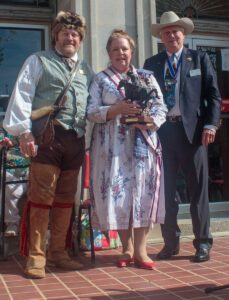
Errol Flannery, dressed as his fourth-great-grandfather, Davy Crockett, presents the Captain Albert Martin Alamo Award to Carolyn and Ken Raney, Stephens County co-chairs of the Alamo Letter Society. (Photo by Carla McKeown/Breckenridge Texan)
“The Captain Albert Martin Award is given to patriots who pursue work in that same spirit of high-minded chivalry, work that embodies the bravery, values and manners of those whose memory shall be forever remembered for having so valuablely given of themselves, even to the last full measure of devotion, in order that we may be given an opportunity to continue our pursuit of happiness in the republic that they so valiantly fought to provide,” Flannery said. “The award itself is a commissioned sculpture by famous Texas artist J. Payne Lara of Navasota, Texas, whose work is displayed across the Lone Star State. His challenge was to capture the spirit of the Alamo rider and all that he stood for: a man on a mission, carrying the hopes of a new nation. In recognition of their efforts to further the promotion and preservation of our shared heritage, and for making this event here in Stephens County truly special and memorable, I am honored, on behalf of the Alamo Letter Society to present the Captain Albert Martin Alamo Award to our friends Ken and Carolyn Raney.”
After accepting the award, the Raneys presented Roach with a Texas flag that flew over the Alamo on Feb. 24, 2025, the day Ken made his presentation to the commissioners and they approved the plaque.
The ceremony wrapped up with the BHS band playing a special rendition of “Texas, Our Texas” arranged by band director Joe Barrow, followed by the benediction by Judy Wolfe.
The Alamo Letter Society’s project is taking place in conjunction with the plans to get the Alamo ready for the Texas Bicentennial in 2036.
In addition to placing the plaque on the courthouse lawn, Stephens County also was recently recognized for being one of the top donors to the Alamo Statewide Stampede, a public fundraising challenge among the 254 counties in the State of Texas to see which county could raise the most funds. The Quail Alley Ranch, owned by the Raneys, and the MT7 Ranch, owned by Mike and Mary Terry and managed by Ty Bartoskewitz, donated a total of $51,500, placing Stephens County at Number 10 out of the 76 counties with ranches that have donated. The two Stephens County ranches will receive a recognition plaque on a life-sized commemorative cattle sculpture on the Alamo grounds, along with other donors contributing $25,000 or more to the fundraising campaign.
Also, earlier this year, the Picketville Chapter of the Daughters of the Republic of Texas sponsored a showing of the 2004 movie “The Alamo” at the National Theatre in Breckenridge. Alamo historian Kolby Lanham introduced the movie and provided a historical analysis of the movie, talking to those in attendance about what scenes in the movie were accurate and which ones were exaggerated for the sake of movie-making.
Click here to see the Breckenridge Texan’s photo gallery from Tuesday’s unveiling ceremony.
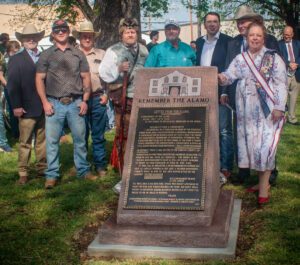
The Alamo Letter monument is located west of the front sidewalk leading up to the Stephens County Courthouse. Pictured after the unveiling are, from left, incoming County Judge Will Thompson, County Commissioners Tanner Wade and David Fambro, Errol Flannery, County Commissioner Mark McCullough, County Judge Michael Roach, and Ken and Carolyn Raney. (Photo by Carla McKeown/Breckenridge Texan)
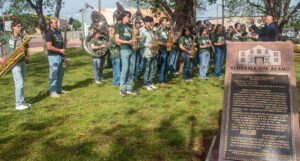
Following the unveiling of the Alamo Letter monument on the Stephens County Courthouse lawn, the Breckenridge High School band played a special arrangement of “Texas, Our Texas.” (Photo by Carla McKeown/Breckenridge Texan)
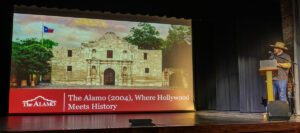
Alamo historian Kolby Lanham speaks at a special showing of the 2004 movie “The Alamo” at Breckenridge’s National Theatre. The Picketville Chapter of the Daughters of the Republic of Texas hosted the free movie for the community on March 2, Texas Independence Day. (Photo by Tony Pilkington/Breckenridge Texan)
Cutline, top photo: Stephens County officials join Carolyn and Ken Raney in unveiling the local Alamo Letter monument on the courthouse lawn. The bronze plaque is mounted on a granite base and features the “Victory or death” letter penned by Lt. Col. William Barret Travis, asking for reinforcements for the Texans facing the Mexican Army at the Alamo in 1836. Click here to see more photos from the ceremony. (Photo by Carla McKeown/Breckenridge Texan)