Stephens County to celebrate 100th anniversary of courthouse, unveiling of Alamo Letter Monument
By Carla McKeown/Breckenridge Texan
On Tuesday, April 14, Stephens County officials will host a two-part celebration at the courthouse: the Courthouse Centennial and the Alamo Letter Monument unveiling.
The event is scheduled to begin at 10 a.m. on the front lawn of the courthouse, located at 200 W. Walker St. in downtown Breckenridge.
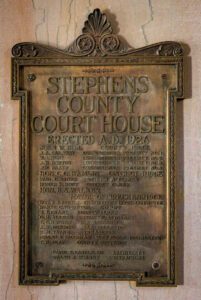
A plaque outside the County Clerk’s office lists the Stephens County and Breckenridge officials involved in securing a new courthouse for the community. (Photo by Tony Pilkington/Breckenridge Texan)
In January 1925, voters in Stephens County approved a bond for a new courthouse to replace the aging 1883 courthouse. The bond passed by 28 votes – 943 for and 915 against – and was initially for $250,000. By the end of the year, officials had decided to combine the courthouse with a new jail on the fourth floor, and the final cost ended up being about $450,000.
In July 1926, there was a ceremony dedicating the courthouse in honor of local war veterans. But, the building wasn’t finished for occupation until Dec. 27, 1926.
According to a newspaper article on July 2, 1926, “reinforcing steel in the new Stephens County courthouse … if placed end to end … would encircle the State of Texas with steel to spare.”
W. B. Pearson, in charge for Walsh & Burney, general contractors of San Antonio, also said the framework used for the building weighs approximately 1,000,000 pounds.
Some of the statistics listed in the 1926 article included:
- There are 3,000 cubic yards of concrete and 200 tons of steel in the new courthouse, not to mention the 16,000 cubic feet of stone in the outside walls.
- 10,000 cubic feet of terra cotta cornice and trimming.
- 100,000 common brick, 60,000 hollow tile, used in partitions and outside walls.
- 50,000 square feet of floor space.
- 15,000 square feet of marble wainscoting in corridors and district courtroom.
- 5,000 square feet of terrazzo and tile floors in corridors, toilet rooms and stair landings.
- 35,000 square yards of plastering on ceilings and walls.
- 1,000 lineal feet of ornamental plaster in district court rooms and corridors.
- 20 tons of structural steel in fire escape and frames.
- 3,000 square feet of walnut paneling in the two district court rooms.
- 20,000 square feet cement floors, with linoleum floor covering over it.
- 20,000 square feet of wood floors.
- 3,000 gallons of paint to cover walls and woodwork.
Today, several parts of the courthouse are used for storing paper documents, including the former jail on the fourth floor and parts of the basement, as well as several rooms on other floors.
As mentioned in the old articles, the courthouse originally had two full-sized courtrooms. There was a courtroom on the west side of the building, almost identical to the current district courtroom on the second floor. However, the jail was directly above the other courtroom, and inmates repeatedly flooded their cells by clogging the toilets. The water eventually damaged the courtroom so much that it couldn’t be used anymore, County Judge Michael Roach said. Today, parts of the courtroom have been repurposed for a law library and the Justice of the Peace’s court.
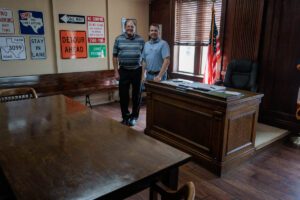
Stephens County Justice of the Peace Steve Spoon, left, and County Judge Michael Roach stand in the JP’s courtroom, which used to be a part of a larger courtroom, almost identical to the current district courtroom. (Photo by Tony Pilkington/Breckenridge Texan)
Alamo Letter Monument
Last year, the Stephens County Commissioners approved a plan to install a plaque featuring the letter written by William Barret Travis to Sam Houston, asking for reinforcements at the Alamo as the Texians faced thousands of Mexicans during the Texas Revolution.
The request to place a copy of the letter at the courthouse was made by Kenneth Raney, a Dallas attorney with deep ties to Stephens County, on behalf of the Alamo Letter Society, a nonprofit organization working to place plaques featuring the letter at all 254 Texas county courthouses. Raney, who has a ranch in Stephens County, is the treasurer general of the Sons of the Republic of Texas, as well as the Stephens County Chair of the Alamo Letter Society. His wife, Carolyn Raney, is the past president general of the Daughters of the Republic of Texas.
The plaque is a copy of the plaque that is on the lawn in front of the Alamo chapel. The monument features a two-foot by three-foot, 204-pound bronze reproduction of Travis’s 220-word letter on a granite base.
The letter is often referred to as the “Victory or Death” letter due to Travis using those words below his signature.
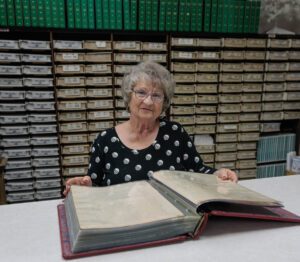
Stephens County Clerk Jackie Ensey shows an old book of deed records that has been professionally sealed to help preserve the historical and legal information. (Photo by Tony Pilkington/Breckenridge Texan)
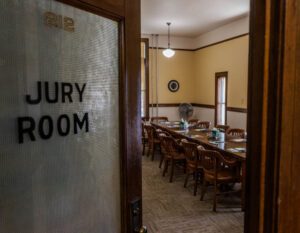
Most of the original 1926 courthouse is still in use today, such as the district courtroom and jury room. The doors, windows, trim and many desks and tables are original. (Photo by Tony Pilkington/Breckenridge Texan)
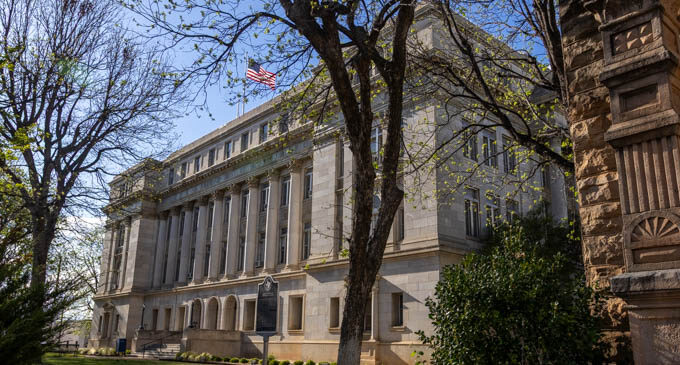
Cutline, top photo: The Stephens County Courthouse was constructed in 1926, and an archway from the previous courthouse was preserved on the lawn. Stephens County officials will host a centennial celebration, along with the unveiling of the Alamo Letter Monument, on Tuesday, April 14. (Photo by Tony Pilkington/Breckenridge Texan)