TSTC welding competition tests real-world skills for area high school students
By Tony Pilkington/Breckenridge Texan
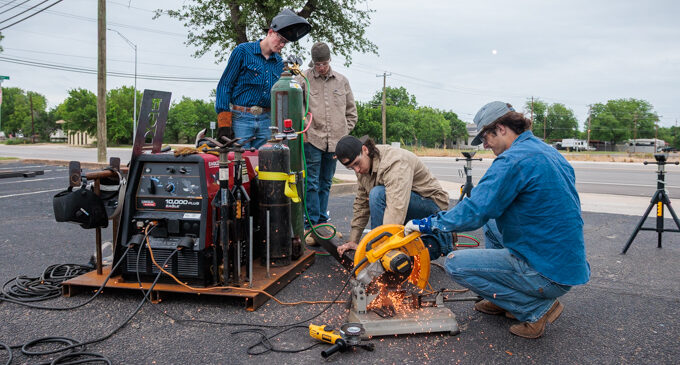
Sparks were flying as high school welding students from across the region, including Breckenridge High School, demonstrated their skills in a bench-building contest last week in the parking lot at Texas State Technical College. Students worked to transform raw steel into finished projects while getting a taste of real-world industry expectations.
All teams were required to build a metal bench with their school’s name cut into the back of the bench, said Stephen Hope, program team lead for welding at TSTC in Breckenridge and Brownwood. They had about six hours to complete their projects. The event was originally scheduled for 17 teams, but recent severe weather forced several schools to withdraw, leaving nine teams able to compete.
“Competitors will have around six hours to build off. Once the build-off is done, judges will come in. They’ll evaluate everything, and they will determine the first, second, and third-place winners,” Hope said.
The prizes for the winners included leather welding hoods, welding caps, welding gloves, baseball caps and safety glasses. Additionally, there were some door prizes given out during the contest.
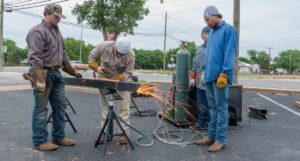
One of two Breckenridge High School teams works on their bench project during the TSTC welding competition on Wednesday, April 29. (Photo by Tony Pilkington/Breckenridge Texan)
From raw tubing to finished bench
On April 29 at the Breckenridge TSTC campus, each team began with identical materials and a blueprint. Hope explained that the contest is designed so that every competitor must depend on basic skills from start to finish. Each was provided with four pieces of square tubing and a blueprint book that served as their guide.
“Each competitor will have to go in and look off of this blueprint. They build it to spec,” he said.
From there, it was up to the students to measure, cut, fit, and weld the bench from scratch. There was a pre-made demo bench on site that students could use to help visualize the final goal.
“They’ll do all of the dimensions, everything on their own,” he said.
Safety first, skills close behind
The competition mirrors the expectations of a modern welding or fabrication shop, starting with basic safety, Hope said. He emphasized that safety comes first, followed by cutting, fabrication, welding and grinding skills. “It’s kind of a general overview of everything that you’ll see in the trade school,” he said.
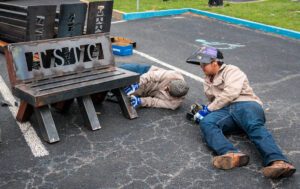
The team from Lorenzo studies and takes measurements on the demo bench during the TSTC welding contest in Breckenridge last week. (Photo by Tony Pilkington/Breckenridge Texan)
Hope said “fabrication” is measuring and cutting pieces, then assembling them at the specific angles needed to create the bench.
“Once they get the pieces measured and cut, they will fab that together, meaning they’re putting two pieces together at certain angles that need to be presented to justify making this bench,” Hope said.
During the judging, Hope said, the judges focus on both precision and overall craftsmanship.
“They are looking at the final product. They’re looking at quality. They’re looking at craftsmanship. They’re looking at how well they paid attention to the blueprint, detail, the measurements, the overall scope of the entirety of the blueprint,” he said.
Hope said two local business owners, Martin Morehart and Justin Davis, served as judges, along with John Fuller, a TSTC welding instructor from Abilene who is a certified welding inspector (CWI).
A CWI is a high-level credential in the welding industry, Hope said, and having Fuller on site underscores the event’s seriousness.
High School Teams, Real-World Stakes
The competitors were high school students from various agriculture and welding programs, including FFA-related programs. Hope said the benches they build remain valuable long after judging ends.
Once the benches are complete and judged, he said the teams take them back to use on their campuses or as part of fundraising efforts.
Unlike some contests, there is no entry fee for the schools. Hope said that many build-offs require participating teams pay a fee and then sell their projects to recoup the costs, but in the TSTC contest, it was all free.
“A lot of the ag schools take and put in a raffle side of things to put the money back into their local ag chapter,” he said, adding that the TSTC event does not have that requirement. “If they want to keep (the bench from the TSTC competition), that’s totally up to them. Or if they want to raffle it and put the money back in their local ag chapter, they can do that as well.”
Although tornadoes and hailstorms prevented eight teams from traveling, organizers will still deliver materials to those schools so their students can build the benches on their own campuses.
“We’re still going to take them their material and allow them to build that,” Hope said. However, they will not be eligible for awards from the event.
A Pipeline to Industry
The contest grew out of TSTC’s existing relationship with area schools. Hope said the college was initially invited several years ago to serve as a judge in similar competitions, which eventually led to TSTC hosting its own build-off event.
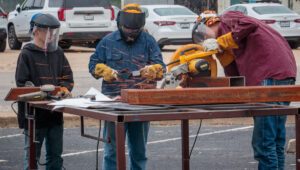
Each team in the contest was given all of the supplies and about six hours to build a bench featuring their school’s name. (Photo by Tony Pilkington/Breckenridge Texan)
He said the event benefits students because it covers nearly every aspect of welding and construction, from safety to fabrication. It also gives them a realistic preview of what they will encounter on job sites.
“Everything that they’re doing is real-world scenarios,” he said.
Graduates from TSTC’s welding programs are securing jobs across Texas and beyond. Hope said former students have gone into local construction companies, a major boiler company in Abilene, pipeline work, and jobs along the coast.
The college trains students in multiple welding techniques so they can handle a variety of roles.
“We see them go out and get shop jobs, which is going to be a variety that may be MIG welding, stick welding, and TIG welding,” Hope said.
Pipeline positions often focus more on stick welding, while boiler work involves a mix of processes. “Our job here is to make sure that they are ready for industry,” he said.
Hope said they are seeing a strong, growing demand for welders, with more jobs opening up than ever before. He also said that wages are higher than they’ve ever been, and students are taking notice.
Certifications and Competency
Students at TSTC can earn either a certificate of completion or an associate degree in welding. Hope said the associate degree is especially attractive to companies looking for welders with more advanced or robotic skills.
Instead of sending students out with portable certification cards for specific processes, TSTC emphasizes demonstrating competence through testing. Hope said that in the welding industry, most companies administer their own weld tests in-house.
“Everywhere you go, you take a weld test, and that’s why we test a high variety of weld situations for each student, so that they’re not stuck in only one area,” he said.
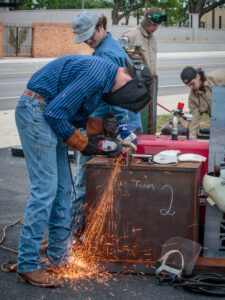
The judges focused on both precision and overall craftsmanship in the TSTC competition. (Photo by Tony Pilkington/Breckenridge Texan)
The program uses demanding bend-out tests, which Hope described as the hardest available. Once students pass those, it serves as proof of their abilities when they move on to employer-specific tests.
Hope said TSTC’s welding programs in West Texas have reached job placement rates in the high 90 percent range, which he called pretty phenomenal as far as job placement. With the help of career services, resume-building support, and job fairs, he said, students are pretty much guaranteed a job before graduation.
The program also stays current with technology, including the growth of robotic welding. Hope said more industries are adopting robotic systems, citing windmill manufacturing as one example.
“That’s done robotically, but a person is still operating the equipment the whole time,” he said.
Despite technological advances, he said, the basics of welding still matter.
“Students have to know the entire basics behind welding, because you are the operator of the machine,” Hope said. He added that welders control “every aspect that (the machine) does, so knowing that, you have to have a welding mindset or welding knowledge in order to incorporate that with the equipment.”
Hope said the goal is to graduate welders who bring more than just technical ability to the workplace. In addition to welding skills, employers want soft skills, computer literacy, and blueprint reading, as well as the ability to communicate with co-workers.
“It’s more than just a welder nowadays,” he said.
For many students, the path from the classroom to a career feels fast. That quick turnaround, he said, generates excitement because students realize they can move into the job market and pretty much go anywhere they want.
Students arrive with a wide range of experience. Some grew up around welding on ranches or family businesses, while others have never touched a welding machine before enrolling.
Hope said it’s really interesting to see the ones who have never touched a welding machine, in general, to see where they start from to where they end. “It’s incredible,” he said.
The program also attracts military veterans and retirees looking for second careers.
In the end, Hope said events like the bench build-off help weld together classroom training, industry expectations and career opportunities — and give students something tangible to show for their work.
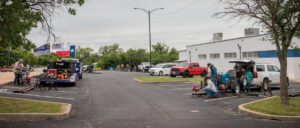
Teams from nine schools participated in the welding contest at TSTC on April 29. Recent storms around the state prevented eight other teams from attending the event. (Photo by Tony Pilkington/Breckenridge Texan)
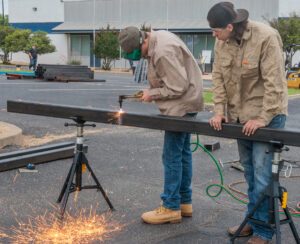
Following blueprints, each team had to measure and cut the pieces, then assemble them at the specific angles needed to create the bench. (Photo by Tony Pilkington/Breckenridge Texan)
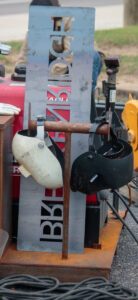
Having a welding certificate or degree often means that welding students can move into the workforce quickly after completing a program. (Photo by Tony Pilkington/Breckenridge Texan)
Cutline, top photo: One of Breckenridge High School’s two teams in the Texas State Technical College’s recent welding contest gets started on their bench project. Each team began with identical materials and a blueprint. (Photo by Tony Pilkington/Breckenridge Texan)