BHS seniors get quick course in decision making with ‘It’s Your Money’ program
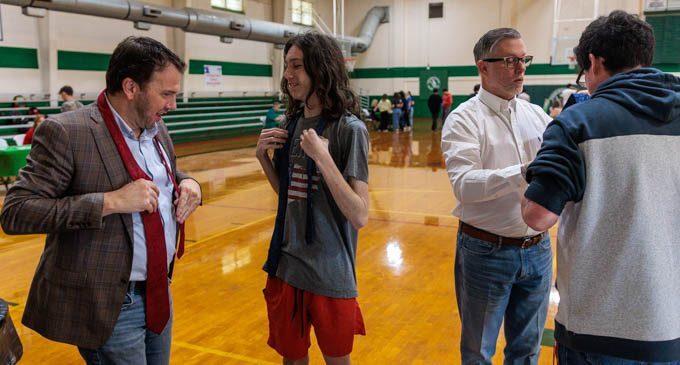
By Carla McKeown/Breckenridge Texan
Breckenridge High School seniors got a glimpse of their future during the “It’s Your Money!” program on Thursday, March 26, sponsored by Texas A&M AgriLife Extension and InterBank, in partnership with the high school.
From how to tie a tie or a twilly to how much having kids could cost them, the Buckaroo Class of 2026 learned a few skills to help them financially navigate the adult world.
Previously known as the “Welcome to the Real World” program, “It’s Your Money!” was designed to teach high school students a variety of skills, such as budgeting and decision making.
The program is coordinated by Sumer Russell, Stephens County Extension Agent, and Luke Grider, community bank president for InterBank.
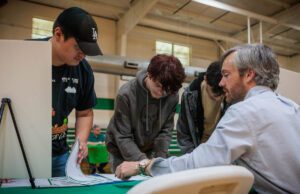
Luke Grider, community bank president for InterBank, helps students determine their clothing budget, as well as work out other budgeting issues during the It’s Your Money program at Breckenridge High School. (Photo by Tony Pilkington/Breckenridge Texan)
The program, which took place in LT Cook Gymnasium, started with each participating student choosing an occupation that comes with a specified monthly salary, as well as the amount they would have to pay in taxes and student loans. Then, they were taught how to write a check, a skill that not many have nowadays, Russell said.
The job spectrum included a variety of jobs with different levels of skills and education requirements. After receiving their job and salary assignments, the students filled out an expenditure worksheet that came in the packet of information they got. They had to make choices, such as whether they wanted to live on a farm, in a town (below 10,000 population), in a city (10,000-50,000), in the suburbs (over 50,000) or in a central city (over 100,000 population). Other choices included what type of home they want to live in, the type of vehicle they want to drive, the type of groceries they would like to buy, and what they want to do for entertainment.
Then, the students visited tables set up around the gym, where they worked out their monthly budgets, based on their salaries and personal interests. At each table, a couple of advisers — community members, InterBank employees, local business representatives, etc. — helped them make the best choices.
New to the program this year was the tie station, helping them prepare for formal job interviews and professions that have a more formal dress code. County Judge Michael Roach and local businessman JB Sparks taught the students — both boys and girls — how to property tie a necktie. Additionally, Russell offered tips on how to tie and wear a twilley, a narrow scarf that can be tied around the neck, tucked in a pocket, wrapped around the handle of a handbag, etc.
As they visited the tables, the students started making decisions about how to spend and save their money. At the transportation table, they decided what type of car they wanted to drive and worked out the payment plan for their choice. For example, if the student wanted to drive a sports car, they could choose from a new model with payments of $575 per month or a used car with payments of $392 per month. Then, the added expenses were also listed, including insurance, gas and maintenance.
There were also tables for utilities, groceries and household expenses, entertainment, clothing, parenthood, insurance, pet ownership, and charitable giving.
Each table offered the students choices and the financial responsibilities of that choice. For example, at the Pet Ownership table, they could choose the type of pet they want and that choice determined how much it would cost them each month. A horse was budgeted at $323, a big dog at $65, a small dog at $32, and a cat at $35. Similarly, the clothing budget could be low-cost ($80 per month) or high-cost ($200 per month). There was also an expense of $25 for laundry supplies and dry cleaning.
Then there was the Reality table, where each student picked a random card to see what kind of real-life type situations they would have to deal. Some of the events included “You break your arm rollerblading. Pay the Emergency Room $200.” Other options were things like “You visit a friend in Dallas for the weekend. Gas and eating out cost $110,” “You were speeding. Pay the $235 speeding ticket,” and “A family member has a birthday. Spend $25 on the gift.” There were also some beneficial options, such as “You complete an extra project at work. Your boss gives you a $100 bonus.” And, “You have a garage sale and sell your old stuff. You earn $176.”
Once they were finished with their choices, the students then had to see how their budgets held up. If they had spent more than they earned, they had to go back to the tables and make different choices. If they couldn’t figure it out on their own, the financial adviser table, staffed by InterBank employees, offered advice.
Along the way, they learned skills such as how to balance a budget and a bank account.
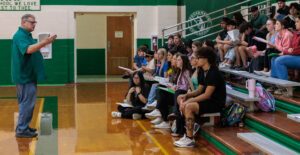
Dr. Jason Johnson, a finance specialist with the AgriLife Extension Service, talks to Breckenridge High School students about what they need to be successful in life. He specifically mentioned “knowledge, skills and ability.” (Photo by Tony Pilkington/Breckenridge Texan)
After the students finished working out their budgets, Dr. Jason Johnson, a finance specialist with the AgriLife Extension Service, talked to them about what they need to be successful in life. He told the students that the key to earning a higher salary is to have “knowledge, skills and ability.”
Johnson encouraged the students to continue educating themselves throughout their lives, as a way to increase their knowledge, skills and abilities.
Although he has a Ph.D. in agriculture economics from Texas Tech University, Johnson told the students that college isn’t the only path to education. He also mentioned apprenticeships and vocational training.
One way of learning more about their profession is to find a mentor. “Find someone who’s already been there, done that, and experienced success in the area we want to pursue,” he said. “You can learn from their successes. You can learn from their failures.”
Johnson told the students that a mentor doesn’t have to be someone they know personally. He said that his mentor is Warren Buffett. Although Johnson has never met the billionaire investor and philanthropist, he has studied the man. “I have read every biography (about him), I’ve read everything he’s written. I’ve learned how he thinks; it’s just like he’s my grandfather,” Johnson said.
He also suggested that, in addition to a regular job that the students may work at, they should consider using their hobbies or other interests to create a second income via a “side hustle.”
“Those side hustles can be turned into very beneficial financially, and when you’re working in something that you’re interested in, it doesn’t really seem like work,” he said.
Click here to see the Breckenridge Texan’s Photo Gallery from the “It’s Your Money” program.
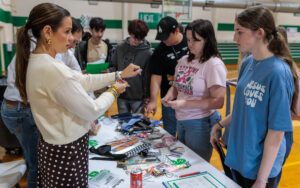
Sumer Russell, Stephens County Extension Agent, offers some tips on styling a twilly during the It’s Your Money program last week. (Photo by Tony Pilkington/Breckenridge Texan)
Cutline, top photo: Michael Roach, left, and JB Sparks, second from right, show Breckenridge High School seniors how to tie a necktie as part of the It’s Your Money program on March 26. Click here to see more photos from the event. (Photo by Tony Pilkington/Breckenridge Texan)