Artifact collector details arrowheads, stone tools of Stephens County at local DRT meeting
By Carla McKeown/Breckenridge Texan
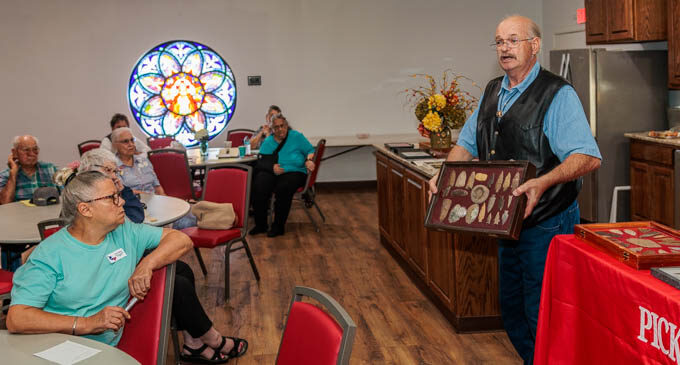
Speaking at a recent meeting of the Daughters of the Republic of Texas – Picketville Chapter, artifact collector Walter Williams of Eastland delivered a presentation on Native American arrowheads and other stone tools, as well as trade routes in Stephens County and the surrounding area.
True Arrowheads vs. Stone Tools
Williams brought with him displays of the arrowheads and other artifacts he’s collected through the years. Additionally, he looked at the arrowheads that some of the attendees brought with them to help better identify their artifacts.
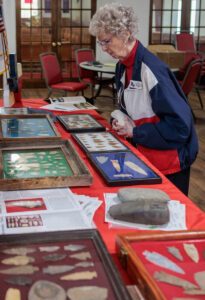
Daughters of the Republic of Texas – Picketville Chapter member Billie O’Neal looks over some of the arrowheads and other artifacts on display during a recent presentation by collector Walter Williams. (Photo by Tony Pilkington/Breckenridge Texan)
He clarified a common misconception regarding artifact classification, explaining that most items identified as “arrowheads” are not true arrowheads. True arrowheads are small and crafted to fit weapon shafts measuring only a quarter-inch to half-inch in diameter; they did not appear until the invention of the bow and arrow during the Woodland period, Williams said.
The larger stone artifacts typically found are dart points, spear points or specialized cutting knives.
Williams outlined the broad archaeological eras represented in Texas artifact collections:
- Paleolithic Period (Clovis and Folsom): Traditionally dated from 9,200 to 13,000 BC, though ongoing excavations at sites such as Texas’ Gault Site are pushing dates back to 20,000 BC or beyond.
- Archaic Period: Dating around 6,000 BC.
- Woodland Period: The era during which the bow and arrow emerged in Texas, beginning with point styles like the Darl point.
Local artifacts often reflect extensive regional manufacturing and trade, he said, showing some of his collection. Many points found in Stephens and Eastland counties were crafted from Callahan Divide chert, quarried from an area near Clyde. Other artifacts found across Texas utilize agates, East Texas palmwood, Bastrop County Colorado River Gravel (CRG), or Black Owl Creek chert from Coryell County.
Williams explained how ancient stone tools were repeatedly re-sharpened, often while attached to handles or shafts, continually shrinking in size over time. Point types such as the Nolan point feature alternate beveling along the edge, allowing hunters to easily re-sharpen the tool in the field.
Stephens County on Ancient Trade Route
According to Williams, Stephens County, Eastland County, and adjacent counties were part of a major north-south trade route leading toward the Arkansas River, which served as a primary trade tributary.
Approximately 5,000 years ago, the area had far more water than it does today, he said. Native Americans were drawn to the region because it offered reliable water and manageable terrain, unlike the drier high plains west of Abilene and Big Spring. Because it served as a natural crossroads, nearly every point type found in Texas appears within Stephens and Eastland counties.
As the area became more populated with settlers and people began finding and collecting the artifacts, the types of arrowheads and other points were typically named after the place where they were found, Williams said.
Among the local artifacts discussed was the “Moran point,” a highly sought-after point type unique to the immediate area, he explained. First excavated at the South Pronghorn site on a creek feeding into Lake Cisco, Moran points — which include small, intricately flaked bird points with serrated edges — were produced by a specific group of Native Americans who inhabited the region. Williams emphasized that true Moran points are found strictly within Stephens County, Eastland County, and potentially one or two neighboring counties, and nowhere else in Texas.
“We do have a point type from this area called the Moran Point that is highly sought after because guess what? They’re found in Eastland County, they’re found in Stephens County, and maybe one or two other counties, and that’s it,” Williams said. “So there was a group of Native Americans that enjoyed living in this area, made this particular type of point, and they’re found nowhere else in Texas.”
Value and Authentication
Highlighting the financial and historical value of local finds, Williams shared an example of a rare Folsom point discovered near Cisco, which originally sold for $5,000 and later resold for $9,000.
He recommended that local collectors secure provenance and professional authentication papers from certified authenticators to establish authenticity and preserve the financial value of significant regional collections for future generations.
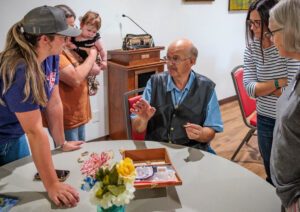
After speaking to those who attended his talk about arrowheads, stone tools and other artifacts, Walter Williams took a look at some of the items brought to the event. (Photo by Tony Pilkington/Breckenridge Texan)
Cutline, top photo: Walter Williams, of Eastland, talks to members of the Daughters of the Republic of Texas – Picketville Chapter and their guests about arrowheads, stone tools and other Native American artifacts collected from Stephens County and the surrounding area. (Photo by Tony Pilkington/Breckenridge Texan)