Lee’s Legion Chapter of DAR honors founder, celebrates 100th anniversary
By Carla McKeown/Breckenridge Texan
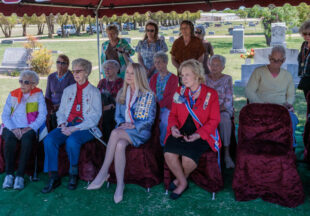
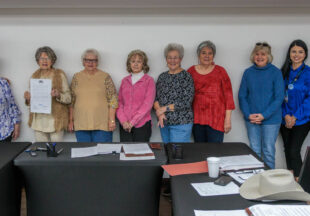
Last week, members of the Lee’s Legion Chapter of the Daughters of the American Revolution gathered in the Albany Cemetery to celebrate the 100th anniversary of the chapter and to honor Emma Crook Davis, who organized the local organization in 1926.
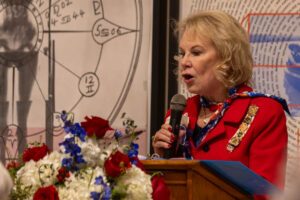
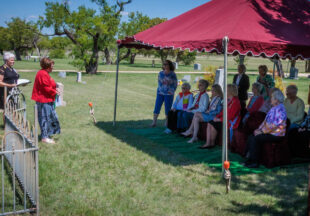
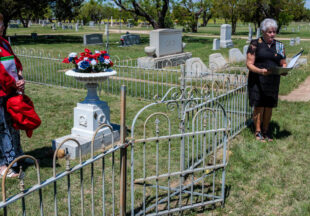
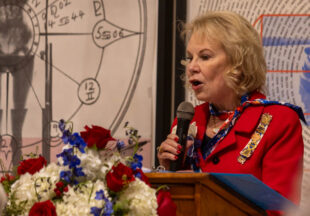
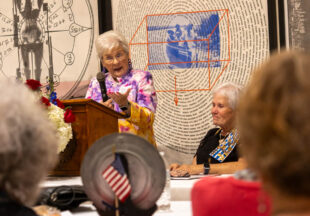
Susan Johnston, the Texas State DAR Regent, speaks at the 100th anniversary celebration for the Lee’s Legion Chapter of the Daughters of the American Revolution in Albany on April 8. Click here to see more photos. (Photo by Tony Pilkington/Breckenridge Texan)
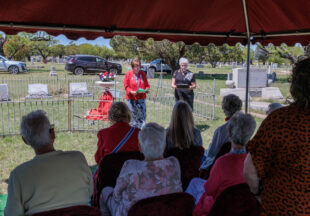
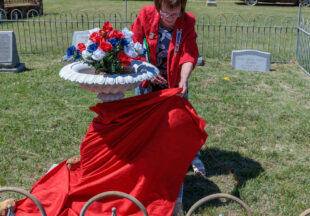
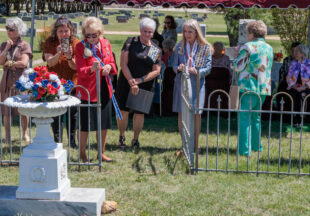
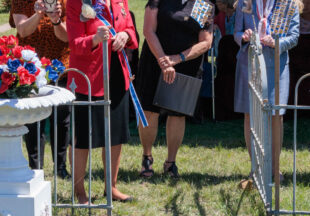
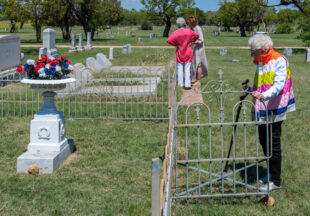
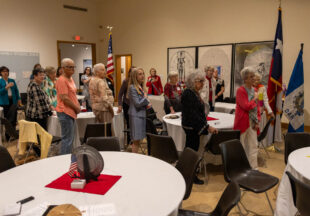
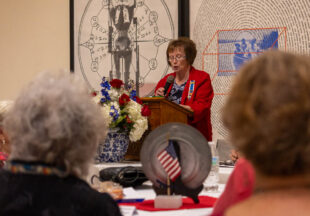
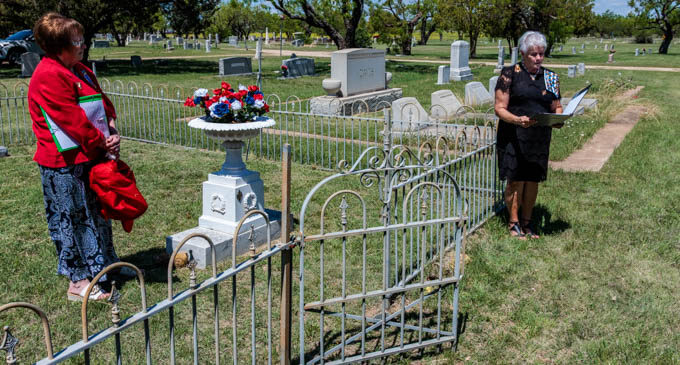
The Wednesday, April 8, event started at the cemetery with a medallion dedication at Davis’ gravesite. Following the ceremony, the celebration moved to the Old Jail Art Center. Local Regent Margie Thompson welcomed the DAR members and guests and club chaplain Lisa Echols led the blessing.
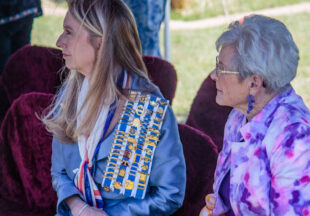
Susan Johnston, the Texas State DAR Regent, and Tammy Poole, the Texas DAR registrar, attended the event.
“We stand here today to celebrate the 100th anniversary of the founding of the Lee’s Legion Chapter. It was organized on April 17, 1926, in the midst of the roaring ’20s,” Johnston said. “It was named in honor of Col. Henry Lee, ‘Light Horse Harry,’ cavalry hero of the American Revolution and the man who gave us the immortal tribute to George Washington: ‘First in war, first in peace and first in the heart of his countrymen.’ From its very founding, this chapter chose to root itself in the ideals of those who pledged their lives to the cause of liberty, as we are also celebrating the 250th anniversary of the Declaration of Independence this year.”
Echols read a proclamation by Albany Mayor Susan Montgomery designating April 8, 2026, as Lee’s Legion Day.
Chapter member Diann Morris presented a brief history of the local DAR chapter, which was founded with 12 charter members. “Through these past 100 years, Lee’s Legion has had 25 regents and at least 253 members,” Morris said. “We currently have 49 members, and currently six prospective members.”
Although the chapter was organized in Albany in 1926, it currently includes members from the surrounding area, including Breckenridge, Albany, Moran and Cisco.
Morris provided the following biographical information on Emma Crook Davis and Col. Henry Lee.
Emma Crook Davis
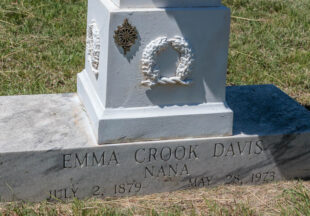
Emma Williams Crook was born in Paris, Texas, on July 2, 1879, the daughter of pioneer settlers James Dennis Crook of Paris and New York City and his first wife Emily Pierre Williams of Kentucky and Texas.
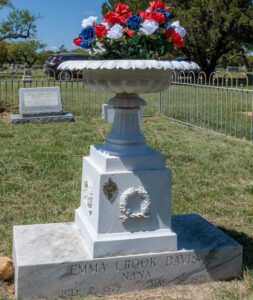
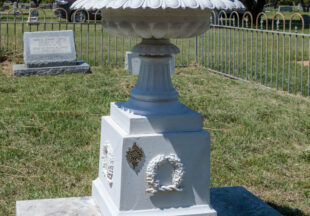
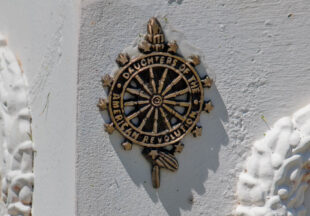
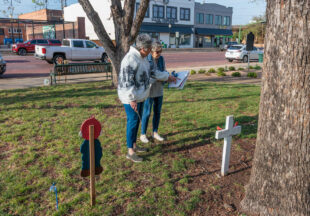
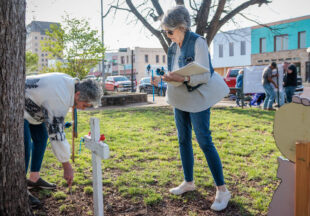
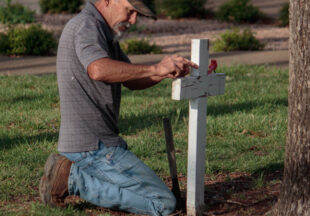
Emma Crook Davis, who organized the Lee’s Legion Chapter of the DAR in 1926, is buried in the Albany Cemetery. A bronze DAR medallion was installed on her monument in honor of her dedication to the organization. (Photo by Tony Pilkington/Breckenridge Texan)
In November 1903 in New York City, Emma married John Merrick Davis of Paris, and they made their home on Highland Ranch, about 10 miles west of Albany. They purchased the G.W.P. Coates Ranch and became involved in the Shackelford County ranching community. They had a daughter, Emily Fairfax Davis Coates.
Emma was active in civic, educational and patriotic organizations from an early age and was a member and officer of many organizations. She was a member of Daughters of the Republic of Texas, which preserves the memory and legacy of those who fought for Texas independence, as well as the Children of the American Revolution, serving as district president in 1923 and state director, mentoring youth in patriotic education and historical awareness. In 1927, she formed the Texas State Society in Fort Worth.
She also served as State Chairman of National Old Trails Road, Better Films Committee, and Daughters of the American Revolution in Paris before organizing the Lee’s Legion Chapter of the Daughters of the American Revolution in Albany in 1926. She served as the Regent for 20 years from 1926 to 1946.
Emma died in Fort Worth on May 23, 1973. She was survived by her daughter, four grandchildren and six great-grandchildren. She is buried in the Albany cemetery and was honored with a DAR memorial medallion on April 8.
Lt. Colonel Henry Lee
The women who founded the Lee’s Legion chapter of the DAR chose that name to honor an American Revolutionary patriot whose son, Robert E. Lee, was a lieutenant colonel at Camp Cooper and selected locations for Indian forts, Fort Griffin and Phantom Hill.
In selecting Henry Lee for the name of their newly organized chapter, they wanted to honor him as a distinguished American general born in Virginia who was considered one of the most daring, vigilant and successful cavalry officers on the side of the colonists.
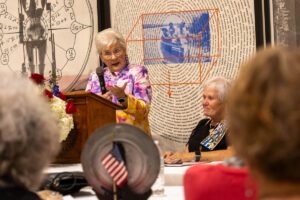
Diann Morris, a member of the Lee’s Legion Chapter of the DAR, talks about the history of the local organization. (Photo by Tony Pilkington/Breckenridge Texan)
Lee’s Legion, more formally the 2nd Partisan Corps, and led by Lt. Col. Henry Lee is one of the best known and familiar units in the Continental army’s history. Gen. George Washington’s original reason for forming legions was for carrying out reconnaissance and raids against the enemy. Lee’s Legion primarily served in the Southern Theatre of Operations and gained a reputation for efficiency, bravery on the battlefield and ruthlessness equal to that of Tarleton’s Raiders. The original unit was raised June 8, 1776, at Williamsburg, Virginia, under the command of Henry “Light Horse Harry” Lee.
Henry Lee III was an early American Patriot and politician who served as the ninth Governor of Virginia and as their representative to the United States Congress. His service as a cavalry officer in the Continental Army earned him the nickname of “Light Horse Harry.”
He was born on Leesylvania Plantation in Prince William County in the Colony of Virginia, the eldest son. He came from a distinguished lineage of diplomats. With the outbreak of the American Revolutionary War in 1775, he became a captain in the army.
In April 1782 at Stratford Hall, Lee married his second cousin, Matilda Ludwell Lee who was known as “the Divine Matilda.” She was the daughter of Philip Ludwell Lee Sr. Matilda had three children Philip Ludwell, Lucy Grymes and Henry Lee IV, before she died in 1790.
In June 1793, Lee married the wealthy Anne Hill Carter at Shirley Plantation. They had six children: Algernon Sidney, Charles Carter, Anne Kinloch, Sydney Smith, Robert Edward, and Mildred.
At Washington’s funeral on Dec. 26, 1799, Lee eulogized him to a crowd of 4,000 as “first in war, first in peace, and first in the hearts of his countrymen.”
During the civil unrest in Baltimore, Maryland, in 1812 Lee received grave injuries while helping to resist an attack on his friend, Alexander Contee Hanson, editor of the Baltimore newspaper, The Federal Republican. He suffered extensive internal injuries and head and face wounds, and even his speech was affected. After an unsuccessful recovery at home, he sailed to the West Indies to recuperate. On his way back to Virginia, he died on March 25, 1818, at the age of 62 at Dungness, on Cumberland Island, Georgia. Light Horse Harry was buried with full military honors, provided by an American fleet stationed near St. Marys, Georgia, in a small cemetery at Dungeness. In 1913, his remains were moved to the Lee Memorial Chapel at University Chapel on the campus of Washington & Lee University in Lexington, Virginia. Lee is buried next to his son Robert.
Click here to see the Breckenridge Texan’s photo gallery from the anniversary celebration.
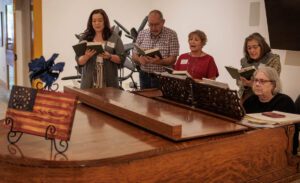
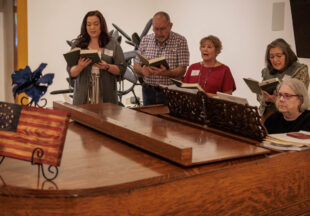
The Viertel family sang patriotic songs at the 100th anniversary celebration of the Lee’s Legion Chapter of the Daughters of the American Revolution. Pictured, from left, are Rachel Viertel, John Viertel, Ladonna Viertel, Melinda Viertel Lucas and Sandy Abel. (Photo by Tony Pilkington/Breckenridge Texan)
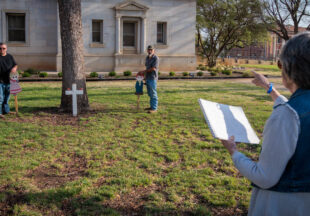
Cutline, top photo: Lee’s Legion Chapter Regent Margie Thompson and club chaplain Lisa Echols lead the medallion dedication ceremony at the grave of Emma Crook Davis, who founded the chapter in 1926. Click here to see more pictures from the event. (Photo by Tony Pilkington/Breckenridge Texan)